
A chair’s fabric estimate is rarely as simple as multiplying its height by its width. A chair upholstery fabric calculator can provide a useful starting point, but the result depends on which parts need covering, the chair’s shape, the fabric’s width and whether its pattern needs matching.
Getting a reasonable estimate before buying fabric can help you avoid delays from ordering too little or unnecessary surplus from ordering too much. In this guide, you’ll learn which measurements to take and how to use them in a practical estimate, with adjustments for chair style, pattern repeat and fabric width.
Think of a calculation as a preliminary allowance, not a final cutting plan. Tufting, piping, curves and other construction details can change the amount required. Fabrico provides chair upholstery in Dubai, where each chair’s details matter when planning the work. The steps ahead will help you prepare an estimate and recognise when a project-specific plan is useful.
Key Takeaways
- Use a chair upholstery fabric calculator as a planning tool, not a definitive cutting plan or purchase quantity.
- Make a labelled inventory of every upholstered chair component and record measurements consistently.
- Consider fabric width, pattern direction and repeat alongside chair details, since each can affect how pieces fit on the fabric.
- Estimate fabric by arranging the required panels against the usable fabric width, rather than adding up surface areas alone.
- For complex shapes or details, a project-specific upholstery plan can refine the estimate for your chair.
What a Chair Upholstery Fabric Calculator Can, and Cannot, Estimate
A chair upholstery fabric calculator uses chair measurements and fabric details to produce a preliminary estimate. It helps organise the factors that affect fabric use, but it cannot replace a cutting layout made for the specific chair and material.
A preliminary estimate predicts fabric needs from measurements; a project-specific cutting plan places each upholstery panel on the chosen fabric and accounts for construction and pattern matching. Treat a calculator’s result as a planning guide, not a guaranteed purchase quantity. The final requirement depends on the chair, the fabric’s usable width and direction, and any pattern-matching needs.
The chair’s overall dimensions are not the same as the dimensions of the pieces that need covering. Upholstery may involve separate panels for the seat, inside and outside back, arms and skirt. For background on the craft, see What is upholstery?, including the materials and techniques that shape how fabric is used.
Which chair details should the calculator represent?
Start by identifying the chair type and listing every upholstered component, rather than recording only its overall dimensions. Note whether the seat cushion or back is removable, since a separate cushion needs its own panels and layout.
Record the chosen fabric’s width and pattern information from its specification. A print may have a clear direction, while a repeating motif may need to align across adjoining pieces. Also note unusual contours, piping, tufting and panels that must match. These details affect how pieces are cut and arranged, even if they do not substantially change the visible area of the chair.
Why can two similar chairs need different amounts?
Two chairs that look alike may differ in seat depth, back height, arm shape or the amount of surface covered. A deeper seat needs larger panels, while a taller back or broader upholstered arms add coverage. Curves and shaped edges can also make the layout less efficient because panels may not fit closely together.
Fabric design matters too. With a plain, non-directional fabric, panels may have more flexibility in orientation. A directional design needs its motifs facing the intended way, which can limit how pieces are turned to fit the fabric width. A repeating pattern may require extra length so the design aligns from one panel to another. The pattern repeat and its placement can affect the layout as much as the chair’s measurements.
Visible coverage is only part of the calculation. Panels also need fabric for construction, including seams and handling during cutting and fitting. The amount depends on the chair’s design and the upholstery method, so a generic calculator cannot reliably set a precise allowance for every project. Use it to prepare and compare estimates, then plan carefully when the chair’s details, shape or pattern make the layout complex.
How to Measure a Chair for an Upholstery Fabric Estimate
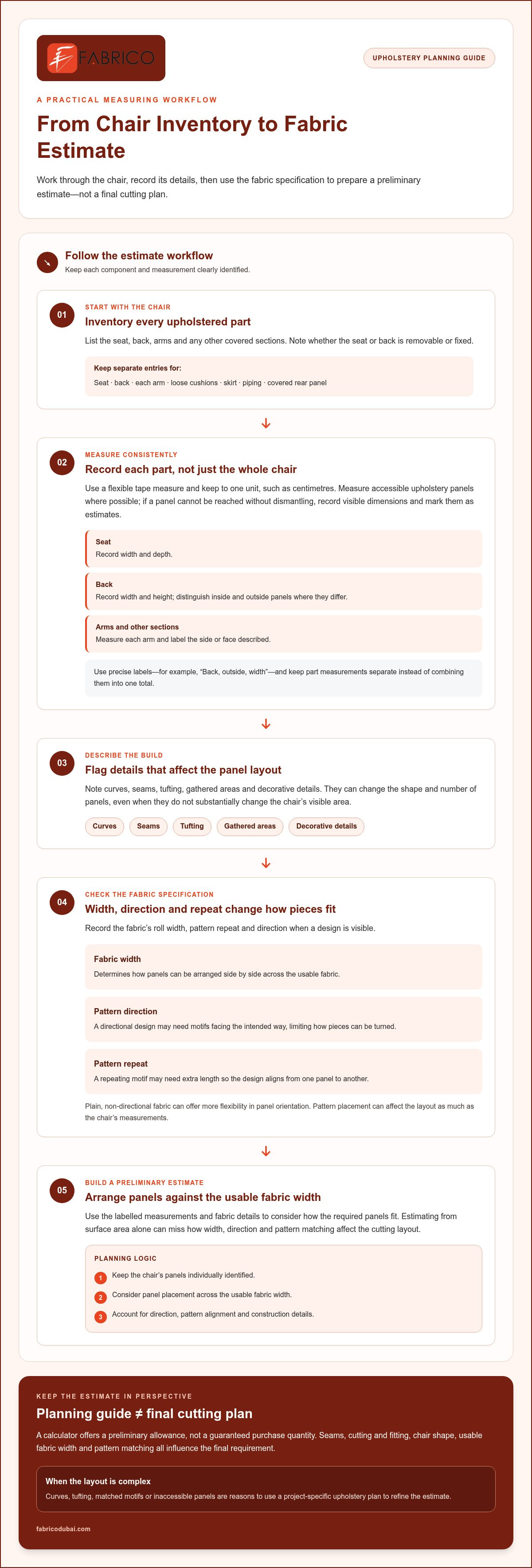
A useful estimate starts with a clear inventory, not a guess based on the chair’s overall height and width. Work through the chair in a consistent order, recording each upholstered section and details that may affect cutting. These notes give a chair upholstery fabric calculator more relevant inputs and make the estimate easier to review.
Measure the seat, back, arms, and other covered parts
Use a flexible tape measure and keep to one unit, such as centimetres. Where upholstery panels are accessible, measure the panels rather than relying only on the frame’s external dimensions. If a panel cannot be reached without dismantling the chair, record the visible dimensions and mark them as estimates.
Follow this order so no covered component is overlooked:
- Identify the upholstered parts. List the seat, back, arms and any other covered sections. Note whether the seat or back is removable or fixed.
- Measure each part. Record seat width and depth, back width and height, and the dimensions of each arm. Label every figure clearly, including the side or face it describes.
- Include additional pieces. Add loose cushions, a skirt, piping or a covered rear panel if they are part of this chair’s upholstery.
- Describe the construction. Note curves, seams, tufting, gathered areas and decorative details. These can change the shape and number of panels, even when the chair looks straightforward.
Label measurements precisely. “Back, outside, width” is more useful than an unlabeled figure, particularly if the inner and outer back panels differ. Keep parts separate rather than combining them into one total, since individual dimensions help show how pieces might fit on the fabric.
Record the fabric information that changes the estimate
Once the chair inventory is complete, note the chosen fabric’s roll width as stated in its specification. Record the pattern repeat and direction if the fabric has a visible design. A motif that must face upright or align across adjacent panels can limit how pieces are positioned and may require more length.
Fabric width determines how panels can be arranged side by side, while a pattern repeat can require extra length to align the design, changing how efficiently the fabric can be cut.
Use the completed notes for a preliminary calculation, not as cutting instructions. Seam allowances and construction requirements depend on the upholstery method, so guessing them can make an estimate misleading. If the chair has complex curves, tufting, matched motifs or inaccessible panels, account for those details in the upholstery plan. For tailored chair upholstery in Dubai, Fabrico works on chairs as individual upholstery projects.
How Fabric Width, Pattern Repeat, and Chair Style Change the Estimate
Measurements are only part of a fabric estimate. The same chair can use fabric differently depending on the material’s usable width, the direction and scale of its design, and its upholstery construction. A chair upholstery fabric calculator is most useful when you consider these variables alongside the panel dimensions.
How pattern repeat and direction affect usable fabric
A plain fabric without a visible direction generally offers more flexibility in how panels are turned and positioned. A directional design, such as a motif that should appear upright, restricts that flexibility. Turning a panel may make its design face sideways or look inconsistent with adjoining pieces.
With a repeating pattern, matching the motif across a seat, back or arms may require starting panels at corresponding points in the design. That alignment can leave gaps in the cutting layout or require extra length. The effect depends on the fabric, the repeat and which panels need to match, so a universal waste percentage is not reliable. Use the fabric’s stated pattern information and consider how the pieces will be laid out.
Why chair construction matters more than a single size label
A simple dining chair with a seat and straightforward back may have fewer distinct panels than an upholstered armchair. An armchair can include separate inner and outer back sections, shaped arms, skirts, loose cushions or tufted areas. Each feature changes the number, outline or orientation of the pieces to cut.
Consider removable cushions as separate components, rather than assuming they are covered by the seat measurement. Separately upholstered panels need their own dimensions and may need to match neighbouring sections.
Chair style affects fabric layout beyond overall chair dimensions because each construction detail changes the shape, number or placement of the panels. A wider roll may allow some pieces to sit beside one another, but it will not necessarily reduce the total fabric. The panels may not fit efficiently across its width, or the design may limit their orientation.
Use this comparison to identify what to factor into a preliminary estimate:
| Variable | Effect on layout | What to record |
|---|---|---|
| Plain, non-directional fabric | Panels may have greater freedom to turn and nest. | Roll width and any usable-width information on the specification. |
| Directional design | Panels may need to face the same way, limiting placement options. | Design direction and which panels must look consistent. |
| Pattern repeat | Matching motifs can require additional layout length. | Repeat information and the panels where alignment matters. |
| Chair construction | Arms, skirts, tufting and separate cushions add or reshape panels. | Component dimensions, contours and upholstery details. |
Compare the panel inventory with the selected fabric specification before treating a calculator result as a buying figure. If pattern matching or complex construction makes the layout difficult to judge, use a project-specific plan to guide your estimate.
A Practical Method for Turning Chair Measurements into a Fabric Estimate
Once you have measured the chair and noted the fabric details, organise them into a panel inventory. This turns a list of dimensions into a practical cutting-layout exercise. Adding up panel areas alone can be misleading: upholstery pieces have different shapes, may need to face a particular direction and must fit within the fabric’s stated width.
Build a panel list before using the calculation
Create a separate row for each upholstered component, recording its name, measured width and length, and quantity. Mark matching pairs, print direction, pattern-alignment requirements and any curved or shaped edges. Keep finished visible dimensions distinct from construction allowances for seams, tucks and fastening. Those allowances depend on the upholstery method, so avoid assuming the same amount for every measurement.
For example, list the seat top separately from its side boxing if both are covered in fabric. Record a pair of arm panels as two pieces, noting whether their shapes mirror each other. This detail helps prevent a small component from being lost inside a broad “chair” measurement. It also makes it easier to identify where a pattern match or awkward curve may affect the arrangement.
Review the layout and estimate before ordering
Use the fabric’s stated width as the boundary for a simple layout sketch. Place the panel shapes within that width, keeping their dimensions, print direction and matching requirements in view. Arrange pieces by their actual outlines, not as neat rectangles. Curves and cut-outs can leave irregular spaces that may not suit another panel.
Check the full inventory against the layout. Count leftover areas only if another required piece genuinely fits there in the right direction and pattern position. If the fabric has a repeat, account for how the motif must align between relevant panels. The total length of the layout provides a preliminary estimate, but the cutting plan and fabric specification determine the order quantity.
- Inventory: List each component, its dimensions and how many pieces are needed.
- Flag constraints: Mark pairs, shaped edges, print direction, pattern matching and construction allowances.
- Arrange panels: Fit the pieces against the stated fabric width without changing their required orientation.
- Review the length: Check the complete arrangement and pattern alignment before treating it as a purchase estimate.
A calculator output is a planning estimate, not a substitute for a verified cutting plan. This matters particularly for complex shapes, tufting or carefully matched patterns, where the construction can change how pieces are cut. If you have documented the chair and fabric but need help planning the upholstery, plan your chair upholstery project with Fabrico in Dubai.
From Fabric Estimate to Bespoke Chair Upholstery in Dubai
A preliminary estimate is useful for early planning, comparing fabric options or preparing a project brief. It becomes less dependable as a purchase figure when the chair has complex contours, tufting, separate cushions, damage or a pattern that needs careful matching. These details need to be considered alongside the chair’s construction and selected fabric when planning the upholstery.
A chair upholstery fabric calculator helps organise your measurements, but it cannot show precisely how every panel will sit on the roll. As you get closer to ordering fabric, review the estimate against the chair and material together.
What to prepare for a project-specific upholstery assessment
Bring together clear photographs and your component measurements, along with the selected fabric specification if you have it. Images of the front, back, sides and underside can show the chair’s shape and construction. Note any loose cushions, visible damage, tufting, piping or skirts, as well as the finish you hope to achieve.
These details help make the upholstery plan specific to your chair. Prepare:
- Photographs that show the chair from several angles.
- Labelled measurements for each upholstered component.
- The fabric’s stated width, pattern repeat and direction, if applicable.
- Notes about construction, damage, removable cushions and preferred finish.
You do not need to create a finished cutting plan yourself. Your notes provide a clear starting point and help distinguish visible coverage from the requirements of construction and pattern placement.
How Fabrico can help move from estimate to upholstery
Fabrico provides bespoke chair and sofa upholstery in Dubai. The service brings the chair’s individual panels and chosen fabric into the upholstery planning process, which is useful when its shape or finish makes a simple layout difficult to judge.
Fabric treatments may also be relevant to the project. Fabrico offers stain and water repellent, anti-bacterial and fire retardant treatments. The appropriate option depends on the project’s requirements and selected materials. These treatments are separate from calculating fabric quantity, but can be considered when planning the finished upholstery.
For additional guidance on bespoke work, explore Fabrico’s upholstery information on the website. If you have documented your chair and fabric details, Fabrico’s bespoke chair upholstery in Dubai can take the project beyond a preliminary estimate and toward a tailored finish.
Take the Next Step with Confidence
Use your chair upholstery fabric calculator estimate as a starting point, then let the chair’s details guide your next decision. Clear measurements and fabric information make a more useful project brief, even when the final cutting plan needs to account for construction and pattern alignment.
Before committing to a fabric quantity, consider whether the chair’s shape, construction or finish calls for a closer look. A bespoke approach can bring the material choice and the chair’s individual details together, rather than relying on a generic allowance.
Fabrico provides bespoke chair and sofa upholstery in Dubai. Share your project details and take the next step toward a considered plan for your chair: discuss your chair upholstery project with Fabrico.
Frequently Asked Questions
How do I calculate how much fabric I need to upholster a chair?
Measure each upholstered component separately, such as the seat, inner back, outer back and arms, then record the fabric’s stated width and pattern repeat. Sketch or list the panels and plan how they can be arranged across the usable width, keeping print direction and motif alignment in mind. The chair’s construction and cutting layout affect the result, so a chair upholstery fabric calculator provides a preliminary estimate, not a guaranteed order quantity.
Can a chair upholstery fabric calculator give an exact amount?
No. A calculator can support planning but cannot reliably determine an exact amount for every chair. The requirement depends on the chair’s construction, the fabric specification, print direction, pattern-matching needs and final cutting plan. For example, a curved arm panel may not nest neatly beside a rectangular seat piece. Use the calculation to organise dimensions and compare options, then account for the specific design before ordering.
Does fabric width change how much upholstery fabric I need?
Yes. Fabric width affects how many panels can sit beside one another and whether their shapes fit efficiently across the roll. A wider fabric can help with some layouts, but it will not always reduce the total length required. For instance, broad separate back panels may not benefit if they must face one direction or align with a print. For a Dubai upholstery project, base the estimate on the selected fabric’s specification and panel layout.
How does a pattern repeat affect chair upholstery fabric calculations?
A pattern repeat can affect panel placement because visible motifs may need to line up across the seat, back or arms. Matching them can shift where each piece starts on the roll and change the amount of fabric used. Directional patterns can also restrict rotation, even if a piece would otherwise fit. The adjustment depends on the specific fabric and chair, so avoid applying the same allowance to every design.
Can I estimate upholstery fabric from the chair dimensions alone?
Overall width, depth and height help describe a chair, but they do not reveal the exact size or outline of every upholstered piece. A separate seat cushion, shaped arms, skirt or covered rear panel can change the cutting layout. Make a component inventory instead. For example, distinguish a loose seat cushion from a fixed seat, since each needs its own panel arrangement.
Should I buy fabric before measuring the chair for reupholstery?
Measure and document the chair before deciding how much fabric to order. Record its upholstered components, then review the intended material’s width, pattern direction and repeat, since these details shape the layout. A preliminary estimate can help with planning, but it is not a final purchase quantity. If the chair has unusual contours, detailed upholstery or motifs that need matching, include those requirements in the upholstery plan before ordering.
Is a fabric calculator suitable for estimating fabric for an upholstered dining chair?
Yes. A calculator can help organise measurements for a straightforward dining chair, but the label alone does not determine the fabric requirement. A chair with a simple seat and back has different layout needs from one with arms, a skirt or patterned upholstery. List each covered component, including any separate cushion, and use the fabric specification to assess how the pieces fit. Treat the result as an estimate, especially if the chair has shaped panels.