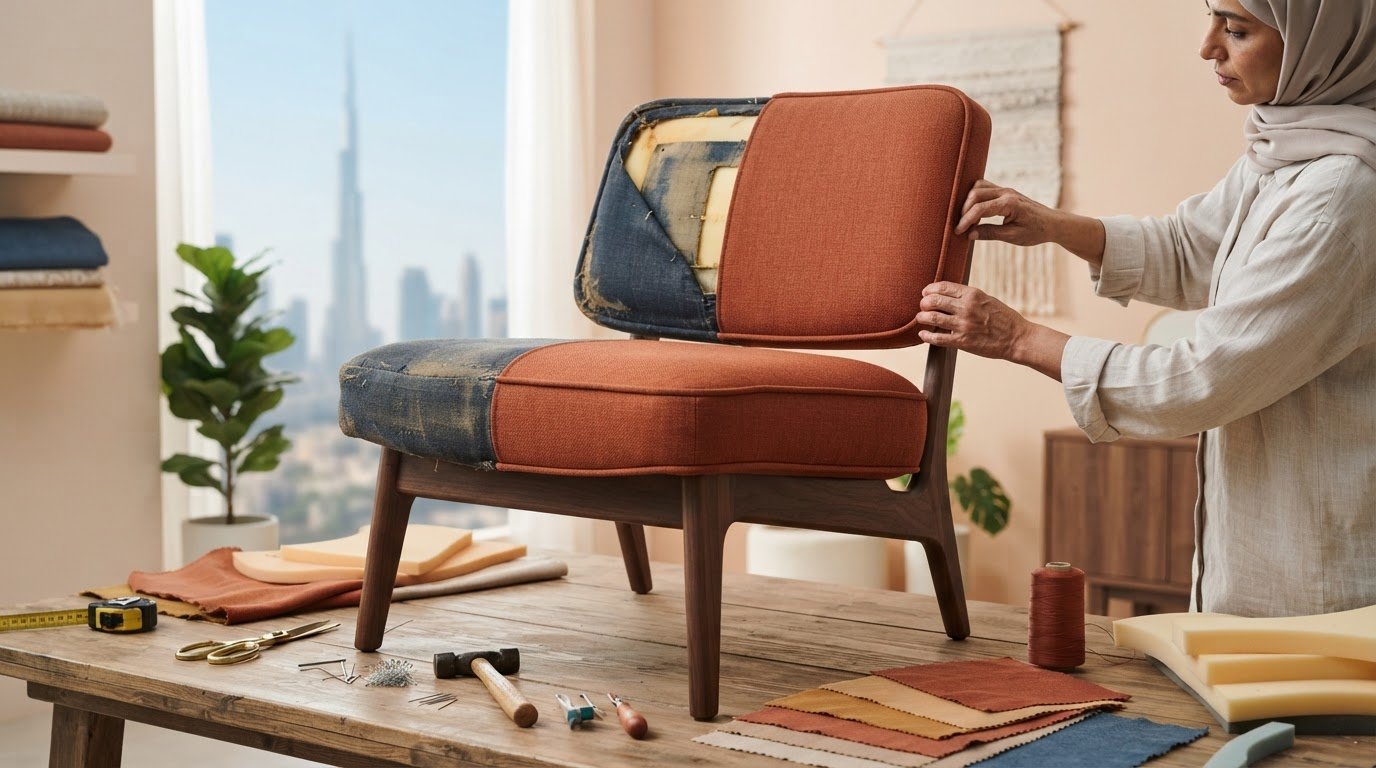

A worn chair isn’t necessarily ready to be replaced. If its frame is sound and its shape still suits your space, fresh upholstery can give it a considered new look. When searching for professional chair reupholstery near me, look for a service that considers the chair’s condition, intended use and fabric, not just its colour.
In Dubai, light, the room’s layout and everyday use can all inform upholstery choices. Start by looking at the chair itself: does it still fit your space, and does it feel right for the way you use it? Then consider which fabric and finish suit the chair’s role and the look you want.
This guide explains what to look for when assessing a chair, how to compare reupholstery with replacement, and what information to prepare for a project. Fabrico provides chair upholstery in Dubai, tailored to the piece and its purpose, drawing on more than 35 years of experience. Use the practical checks below to decide what you want to preserve and what you’d like to change.
Key Takeaways
- Look at the frame, padding and visible wear before deciding whether reupholstery may suit the chair.
- Choose fabric by considering how often the chair is used, the feel you prefer and the look you want.
- Compare reupholstery with replacement by weighing the chair’s condition, fit, intended use and personal value.
- Before arranging professional chair reupholstery near me, note the chair’s dimensions, condition, location and everyday use.
- Fabrico’s chair upholstery service in Dubai is tailored to the piece and its purpose.
Professional Chair Reupholstery Near Me: What the Service Can Change
A chair can look tired without losing the shape that makes it right for your room. Reupholstery replaces the worn covering and can address the padding when the project calls for it, while retaining the chair’s existing form. For anyone searching for professional chair reupholstery near me, that distinction is useful: the service refreshes an existing piece rather than replacing it with ready-made furniture.
What does professional chair reupholstery involve?
Chair reupholstery involves removing the old covering and fitting new upholstery to the chair’s existing shape. The work needs to account for the piece’s contours and the way its seat and back are constructed. Upholsterers use traditional and modern methods, as outlined in this overview of the history and techniques of upholstery.
Fabric has a strong influence on the finished look. Colour and pattern can make a familiar chair feel understated, distinctive or more in keeping with nearby furnishings. Texture affects both appearance and feel, while the chair’s padding contributes to how it feels to sit in. If cushioning looks compressed or uneven, consider it as part of the project rather than selecting fabric alone. The right scope depends on the chair’s condition and intended use.
Fabrico’s bespoke upholstery services in Dubai are tailored to the chair and its purpose. This approach is useful for pieces with distinctive lines or details you want to retain while updating the covering.
Which signs suggest a chair may benefit from reupholstery?
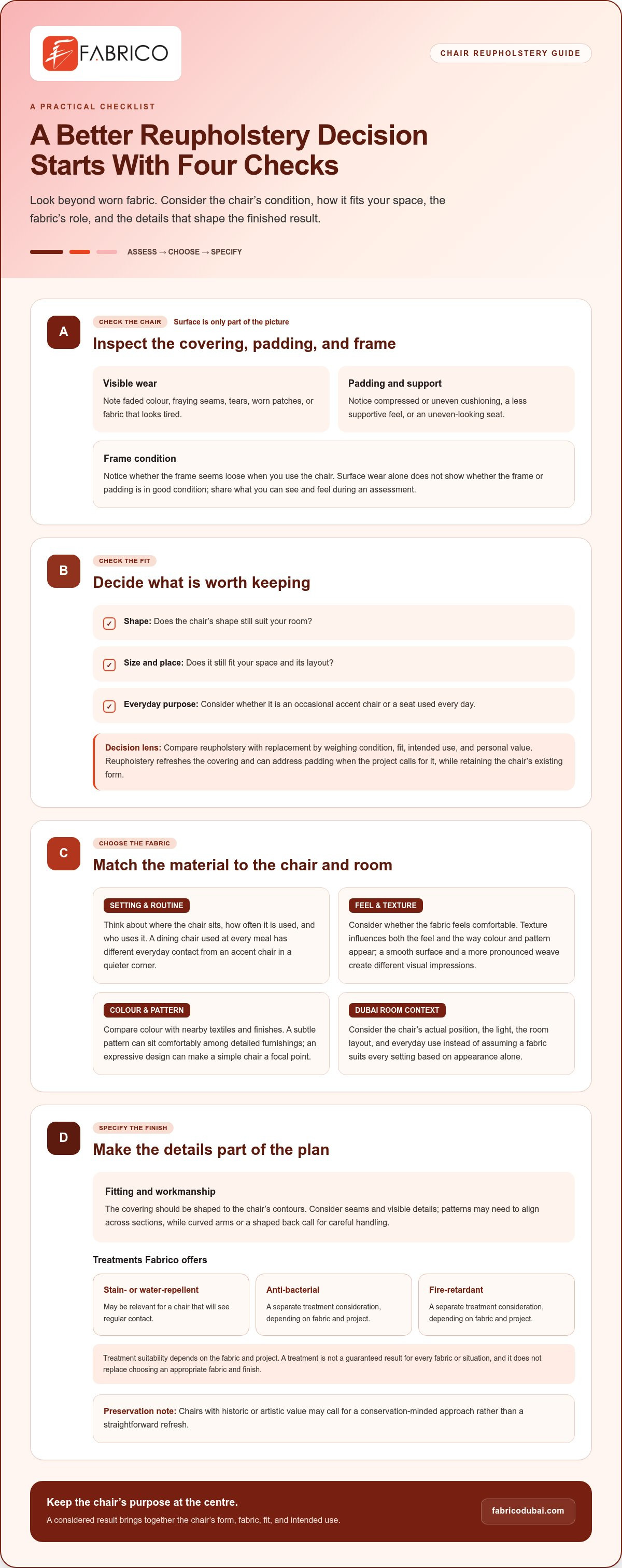
Faded colour, fraying seams, tears, worn patches and fabric that looks tired are visible signs of surface wear. They don’t, by themselves, show whether the frame or padding is in good condition. If the chair still fits your room and serves its purpose, consider its overall condition before deciding to replace it.
Look beyond the cover. Notice whether the chair feels less supportive than before, whether the seat looks uneven, or whether the frame seems loose when you use it. These observations are useful to share during an assessment, but they don’t identify the cause. Frame condition matters because reupholstery renews the upholstery while retaining the chair’s existing form. Intended use matters too: an occasional accent chair has different demands from a seat used every day.
Record what you can see and feel, then ask yourself whether the chair’s shape and size still suit your space. This gives a more complete starting point than choosing fabric based on a photograph alone.
Chair Reupholstery in Dubai: How Fabric and Craft Shape the Result
Fabric affects more than a chair’s colour. Its texture, pattern and feel shape how the piece looks in a room and feels in use. Careful fitting helps the upholstery follow the chair’s lines. To choose well, consider where the chair sits, how often it is used, who uses it, and how its fabric will relate to nearby furnishings.
How should you choose upholstery fabric for a chair?
Start with the chair’s setting and routine. A dining chair used at every meal has different everyday contact from an accent chair in a quieter corner. Consider whether the fabric feels comfortable and whether its appearance suits the room. A subtle pattern can sit comfortably among detailed furnishings, while a more expressive design can make a simple chair a focal point.
Compare colour with the room’s other textiles and finishes instead of choosing it in isolation. Texture also affects how colour and pattern appear. A smooth surface and a more pronounced weave can create different visual impressions. In a Dubai home, consider the chair’s actual position and use rather than assuming a fabric will suit every setting based on its material or appearance. Use the fabric information available for the project to guide your choice.
Workmanship brings the choice together. The upholstery needs to be shaped and fitted to the chair, with attention to its contours, seams and visible details. A pattern may need to align across sections, while curved arms or a shaped back call for careful handling so the covering sits neatly. These details help the new fabric complement the chair instead of feeling like a separate addition.
When can fabric protection treatments be relevant?
Fabric treatments can be considered alongside upholstery choices. Fabrico offers stain- or water-repellent, anti-bacterial and fire-retardant treatments. Each has a different purpose, and suitability depends on the fabric and project. A treatment is not a guaranteed result for every fabric or situation, so consider the chair’s use and the material selected.
For a chair that will see regular contact, stain- or water-repellent treatment may be relevant to the project. Learn more about water-repellent upholstery treatment in Dubai in the context of fabric care. Anti-bacterial and fire-retardant treatments address different considerations. Neither replaces choosing an appropriate fabric and finish.
Some chairs also have historic or artistic value and may call for a conservation-minded approach. The American Institute for Conservation’s Textile Specialty Group offers resources on upholstery conservation by AIC, a useful distinction when preservation, rather than a straightforward refresh, is central to the decision.
With professional chair reupholstery near me, a considered choice brings together the chair’s form, the fabric’s appearance and its expected use. Fabrico tailors chair upholstery to the piece and its purpose. Visit Fabrico’s upholstery service to explore the service.
Reupholster or Replace a Chair? Compare Condition, Fit, and Value
A chair with worn fabric can still be right for your room, but new upholstery won’t solve every problem. Compare its condition, how well it fits the space, what you need it to do, and whether keeping it matters to you. This check helps you weigh reupholstery against replacement without assuming one option is always less costly or more practical.
When might reupholstering an existing chair make sense?
Reupholstery may suit a chair that fits the room and serves its purpose, especially if you value its shape or personal history. New fabric can change its appearance and help it sit more comfortably with updated surroundings. Suitability still depends on the chair’s frame, condition and project requirements. An assessment can help distinguish worn upholstery from concerns that need closer attention.
| Reupholstery may suit the chair when… | Replacement deserves consideration when… |
|---|---|
| The chair fits the room and meets your everyday needs. | The size, shape or function no longer works for the space. |
| You value its form, familiarity or personal significance. | You no longer want to keep the piece or its design. |
| The main concern is faded, damaged or tired upholstery. | There are concerns about the underlying structure that need assessment. |
| You want to change its appearance while retaining its existing form. | The project requirements don’t align with the result you need. |
When should replacement remain part of the decision?
Consider whether the chair still supports the way you use the room. A dining chair that feels awkward at the table or an accent chair that takes up more space than it can comfortably serve may not become a better fit through new upholstery alone. Think about function as well as appearance: reupholstery renews the covering but retains the chair’s existing form.
Separate surface wear from questions about the chair beneath it. A tear or faded patch shows the condition of the covering, but it doesn’t tell you whether the frame is sound. If the chair feels unstable or its shape has changed, share those observations for a closer assessment rather than assuming fabric work will resolve them.
Value includes more than a direct price comparison. Consider whether the chair’s dimensions suit the room, whether it remains comfortable for its intended use, and whether keeping it has meaning for you. If you’re searching for professional chair reupholstery near me, note what you want to preserve and what you need to change. That gives the project a clear purpose.
Replacement may be more suitable if the chair no longer meets your needs or its condition and project requirements make a refresh inappropriate. Reupholstery may be worth exploring when the piece remains a good fit and you want to renew its appearance. Weigh the chair as it is against the role you need it to fill next.
Prepare for Professional Chair Reupholstery in Dubai
A little preparation makes it easier to describe what you want to keep and what you hope to change. Before arranging chair reupholstery, gather basic details about the piece, its condition and the room where it belongs. These notes help focus the project discussion without requiring you to decide every technical detail in advance.
What information helps plan a chair upholstery project?
Start with a clear record of the chair. Take photographs from the front, back and sides, then add close-ups of visible wear such as fading, tears, loose seams or areas that look compressed. These references make it easier to discuss the chair’s details and the scope of the work.
Then note the information that gives the project context:
- Dimensions: Record the chair’s overall width, depth and height, along with any measurements that matter for its placement.
- Current condition: Describe what you can see and feel, including worn upholstery or changes in how the chair sits. Treat these as observations, not a diagnosis of the frame.
- Location: Identify the room and where the chair sits, such as beside a window, at a dining table or in a reception area.
- Everyday use: Explain whether it is occasional seating, used regularly or shared by different household members.
- Design preferences: Gather colour references and note whether you prefer a coordinated look or a more distinctive pattern or texture.
- Practical requirements: Describe the kind of contact the chair receives and your priorities for its everyday role, without assuming a particular fabric specification.
A photograph of nearby furnishings can show how the chair relates to the room. If you have a preferred direction but no exact material in mind, describe the appearance and feel you’re aiming for. Fabric choices can then be considered in relation to the chair and its intended use.
How can you plan the chair’s place in a Dubai home?
Look at the room in the light in which you use it. Colour can appear different beside a bright window than in a shaded corner, so consider the chair’s position alongside the walls, flooring, curtains and cushions. In a Dubai apartment, for example, a chair near a window can be chosen to work with the room’s existing tones, while a chair in a more central position could become a focal point.
Think about the chair’s daily role before settling on a design. An occasional reading chair and a seat used throughout the day have different patterns of contact. Share that distinction and your visual preferences so the upholstery can be tailored to the setting and purpose.
With measurements, photographs and preferences ready, you can have a more focused conversation about the chair. Explore Fabrico upholstery services to start planning a tailored project for your piece.
Choose Fabrico for Professional Chair Reupholstery in Dubai
Once you’ve considered the chair’s condition, its place in your home and the look you want, choose a service suited to the piece. Fabrico is a Dubai-based soft furnishings and upholstery specialist, providing chair and sofa upholstery tailored to each project. The company’s more than 35 years of experience offers a foundation for discussing how the chair’s existing form, intended use and fabric choices can come together.
What makes Fabrico a considered choice for chair reupholstery?
Chair upholstery involves more than selecting a new covering. The chair’s lines, visible details and purpose all inform the work. An occasional seat, for example, has a different role from one used throughout the day. Fabrico tailors its upholstery service to the chair and the client’s requirements rather than applying one standard design to every piece.
This approach can help when you want to retain a chair’s character while refreshing its appearance. A discussion of its condition and the look you prefer can help define the direction for the upholstery. Fabrico’s chair and sofa upholstery services are part of its wider focus on soft furnishings, with each piece considered in relation to its setting.
Fabric care can also form part of the project. Fabrico offers stain- or water-repellent, anti-bacterial and fire-retardant treatments. Their relevance depends on the fabric and the project, and they don’t guarantee a particular result. Consider them alongside the chair’s expected use, with the selected fabric and upholstery work remaining central to the piece.
What is the next step for your chair?
Bring together the details you’ve gathered: photographs, dimensions, visible wear, where the chair is used and how often it serves as a seat. Add what you hope to preserve, such as a distinctive shape or familiar detail, and what you’d like to change. You might prefer a calmer colour, a more expressive pattern or a different texture.
These details provide a useful starting point for discussing the project. You don’t need to settle every choice in advance. Because the upholstery is tailored to the chair and your requirements, sharing practical needs as well as aesthetic preferences keeps the discussion focused on the piece. If you’re looking for professional chair reupholstery near me, Fabrico’s Dubai-based service offers a project-specific approach backed by longstanding upholstery experience.
Share your chair’s condition, intended use and preferred look with Fabrico. Discuss your chair upholstery project with Fabrico.
Give Your Chair a Thoughtful Next Chapter
A chair you’ve chosen to keep can become a starting point for a more personal room. Before deciding on its final look, consider what you want it to express: quiet harmony with its surroundings, a distinctive accent or a familiar seat refreshed for its next role. That direction can turn a search for professional chair reupholstery near me into a considered project, rather than a choice based on appearance alone.
You don’t need to have every detail settled. A few photographs, a sense of how the chair is used and an idea of the colours or textures you like can give the conversation a helpful beginning. From there, the project can take shape around the chair and the result you have in mind.
Start planning your chair upholstery refresh with Fabrico and take the next step towards a piece that feels suited to your Dubai home.
Frequently Asked Questions
Can any chair be professionally reupholstered?
Not every chair is a suitable candidate; its condition and the work required need consideration. A dining chair with worn covering may present a different project from an ornate chair with loose joints or extensive damage. Before searching for professional chair reupholstery near me, note any wobbling, unusual noises or changes in shape. These details help an upholstery specialist assess whether renewing the covering suits the piece.
How long does chair reupholstery take?
The time required depends on the chair’s construction, the scope of the upholstery work and the selected material. A straightforward seat covering and a chair with detailed contours or multiple upholstered sections involve different tasks. Share photographs and details of the chair early in the project discussion so the work can be considered on its own requirements, rather than relying on a one-size-fits-all estimate.
What upholstery fabric is suitable for a chair used every day in Dubai?
Choose with the chair’s routine in mind instead of relying on a generic “best fabric” label. Consider how many people use it, whether meals or other activities take place nearby, and the feel and appearance you prefer. A frequently used desk chair, for example, has different patterns of contact from occasional guest seating. Describe these needs when discussing upholstery in Dubai, and base fabric decisions on the material details available for the project.
Can a chair be reupholstered in a different colour or pattern?
Yes, a reupholstered chair can have a different colour or pattern, depending on the fabric selected and the chair’s shape. A small-scale pattern may suit a compact seat, while a bold motif can create a focal point. Consider how the design will appear across the chair’s sections, especially on a curved back or arms. Comparing fabric references with the room’s existing colours can help clarify your preference.
Can upholstery fabric receive stain- or water-repellent treatment?
Yes, Fabrico offers stain- or water-repellent treatment for upholstery projects. Whether it suits a particular chair depends on the fabric and project, and treatment isn’t a guarantee against marks or water damage. Consider how the chair is used and what concerns you want to address. Discussing those details alongside the fabric choice helps put the treatment option in context.
How should I care for a newly reupholstered chair?
Follow care guidance suited to the specific fabric rather than applying a universal cleaning method. As a general habit, remove dust gently and attend to spills promptly by blotting instead of rubbing. Avoid applying household cleaners or stain removers without checking that they’re appropriate for the upholstery, since an unsuitable product may affect its appearance. If the chair has a fabric treatment, follow the care instructions provided for that fabric and treatment.
Is it worth reupholstering a chair with sentimental value?
It can be worth exploring if keeping the chair matters to you and the piece remains appropriate for your needs. Sentimental value is personal, so consider what you want to preserve, such as its familiar shape or a detail associated with a family member. An assessment can help clarify the chair’s condition and the work involved. You can then weigh the project requirements against the meaning the chair holds for you.