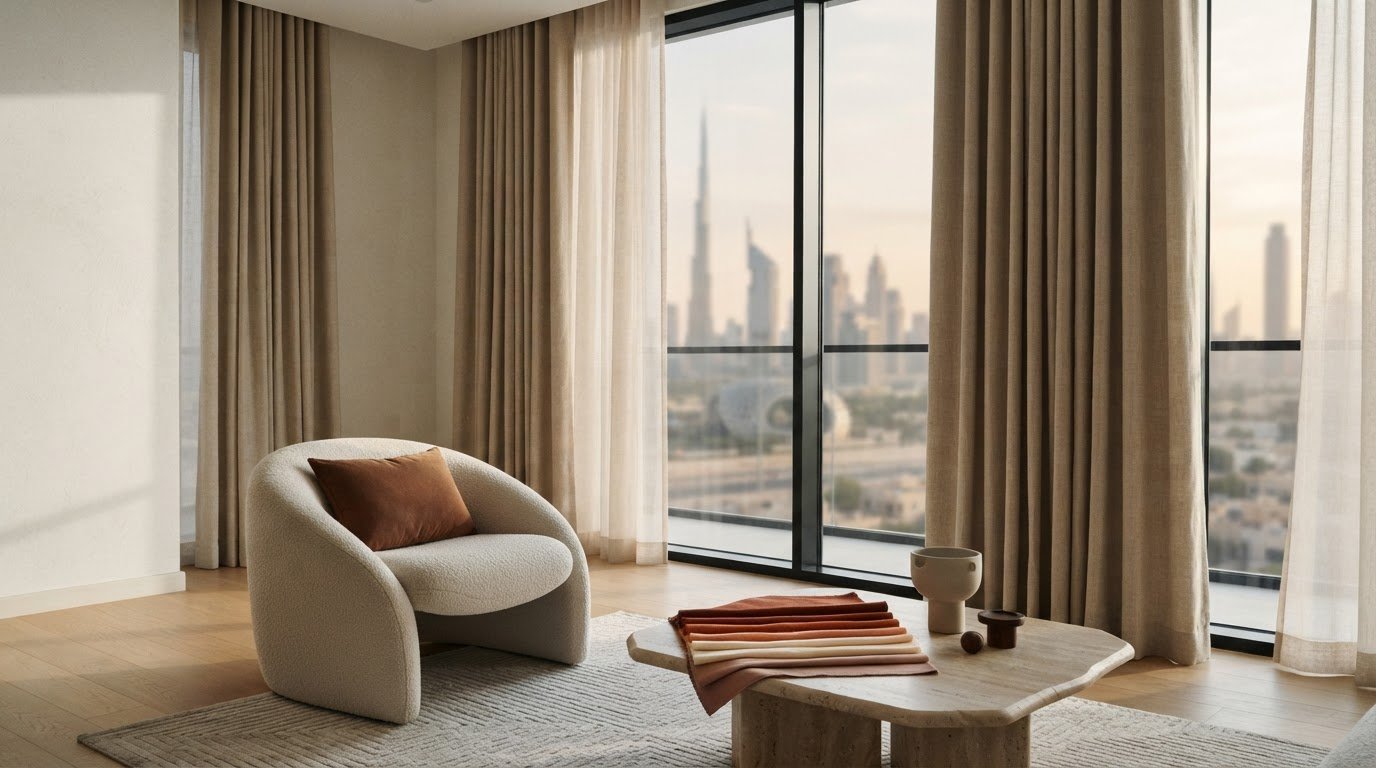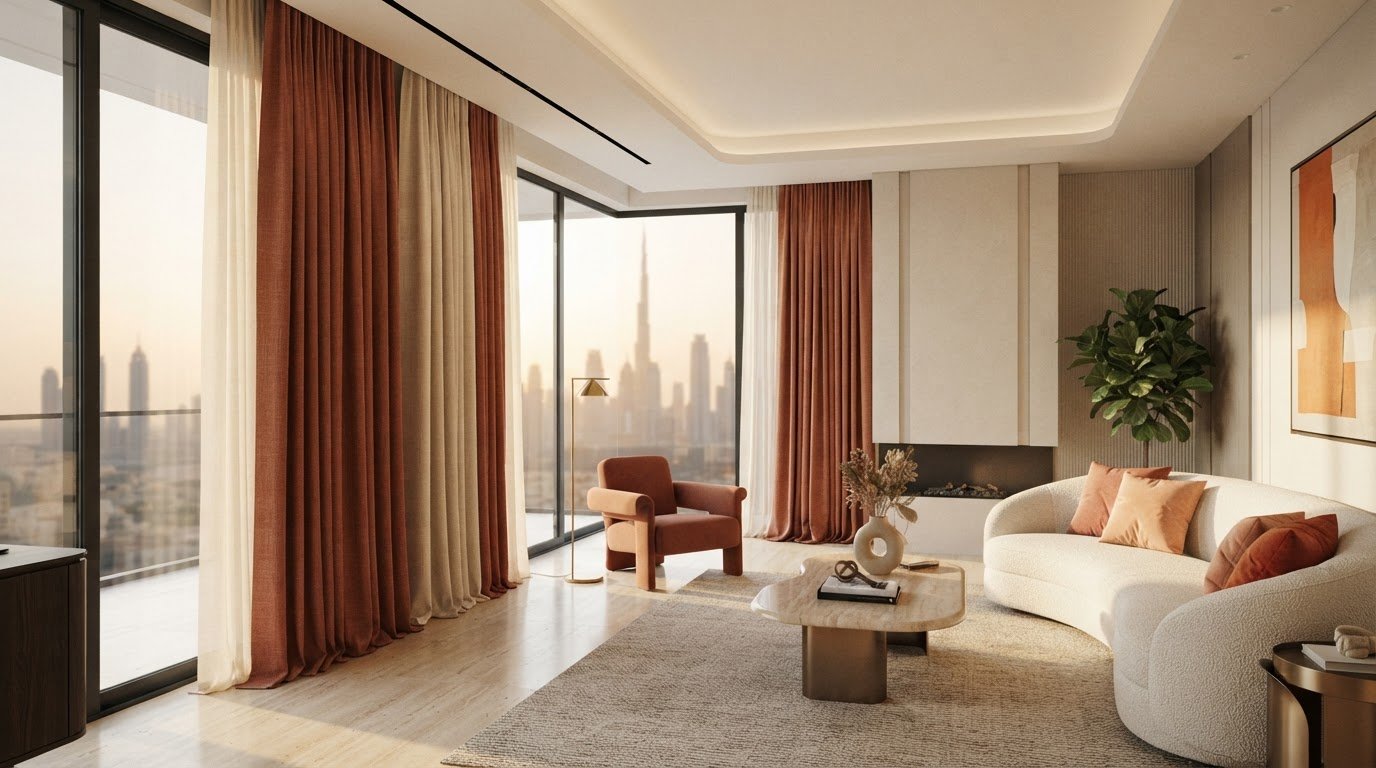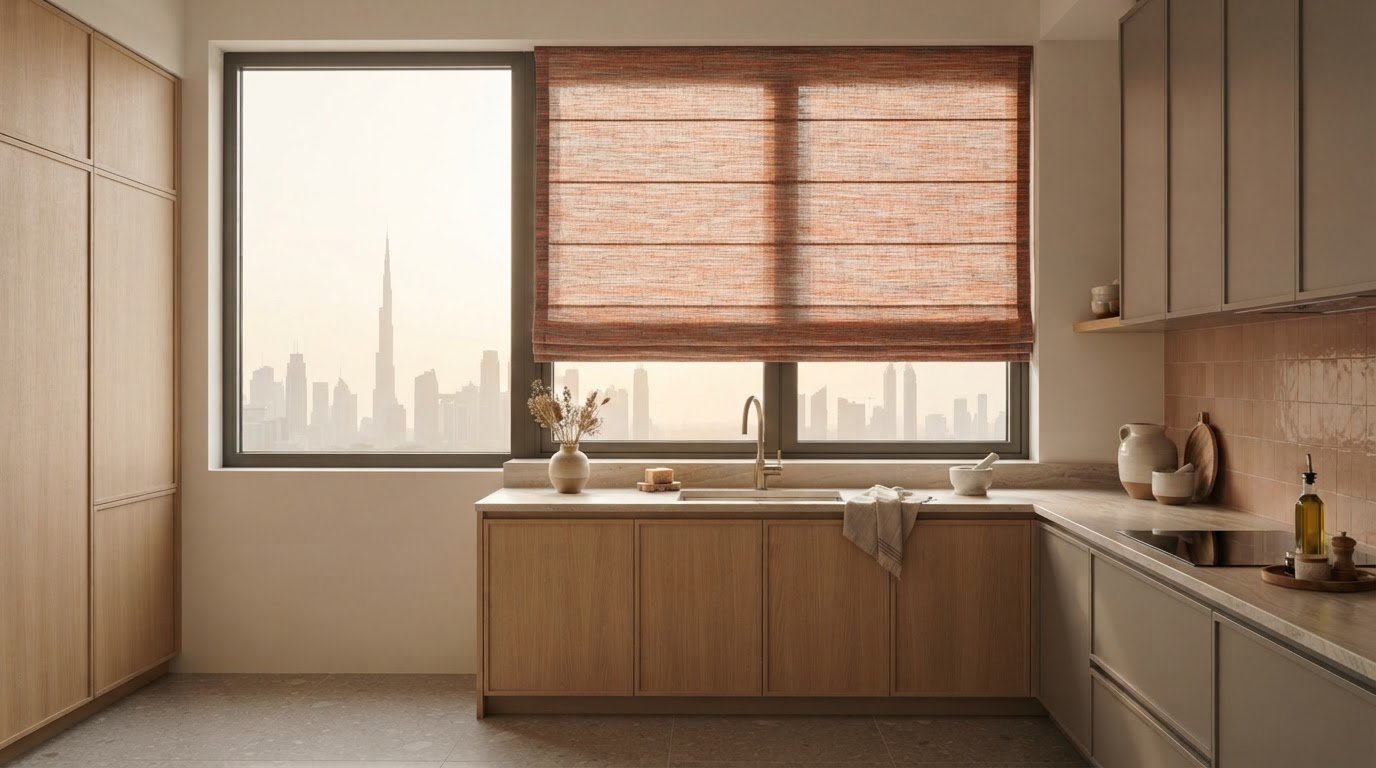

What if the most elegant shade for your kitchen is also the wrong one for its window? In Dubai, strong daylight, cooking splashes and the need for privacy all affect how a Roman shade works. Choosing custom Roman shades for kitchen Dubai homes means looking beyond colour to consider the room’s daily conditions.
It’s reasonable to want a soft, tailored finish without sacrificing natural light or choosing fabric that’s difficult to care for. The right balance depends on where the window sits, how close it is to a sink or cooking area, and whether handles or cabinetry affect the shade’s movement. Lining matters too: a more substantial option can increase privacy and reduce incoming light, while a lighter treatment can keep the kitchen brighter.
This guide explains how to compare Roman shade styles, practical fabrics and lining choices for your kitchen. It also covers details that support a precise fit, including recess depth, window measurements and nearby obstructions, so you can make a considered choice for your Dubai home.
Key Takeaways
- Choose custom Roman shades for kitchen Dubai homes by considering how the window is used, not appearance alone.
- Compare fabric texture, opacity and care guidance to find an option that suits your kitchen routine.
- Consider how lining affects incoming light and privacy before settling on a finished look.
- Compare Roman shades with curtains and other blinds based on window access, fit and the effect you want.
- Record window measurements, recess details, handles and nearby cabinetry to guide a tailored design.
Why custom Roman shades can suit a Dubai kitchen
A kitchen window treatment needs to feel considered while working around the room’s practical demands. It may need to soften strong daylight, provide privacy from nearby homes and fit neatly beside worktops or cabinetry. Custom Roman shades for kitchen Dubai homes can be made to suit a particular window, rather than relying on a standard size or treating every kitchen alike.
A Roman shade is a fabric window covering that folds into horizontal pleats as it is raised. When lowered, it covers the window with a clean, fabric-led appearance. When raised, it gathers into a stack at the top. The amount of visible glass and the overall effect depend on the window, the shade’s proportions and how you use it throughout the day.
What makes a Roman shade different from a curtain?
A Roman shade sits close to the window, creating a defined frame without fabric panels extending to either side. This can suit a kitchen where counter space, a nearby door or a narrow wall leaves little room for curtains. Curtains create a softer, more flowing effect and add fabric around the window, while a shade keeps the treatment visually contained. Neither approach suits every room. For a broader comparison of pleated curtain styling, explore this guide to American pleated curtains in Dubai.
A tailored Roman shade can also connect the window to the kitchen’s finishes. Its colour and texture may complement cabinetry, flooring or a dining area. Consider the shade’s coverage alongside your need for privacy and daylight. The aim is a finish that works with the room without making the window harder to use.
Which kitchen conditions should shape the design?
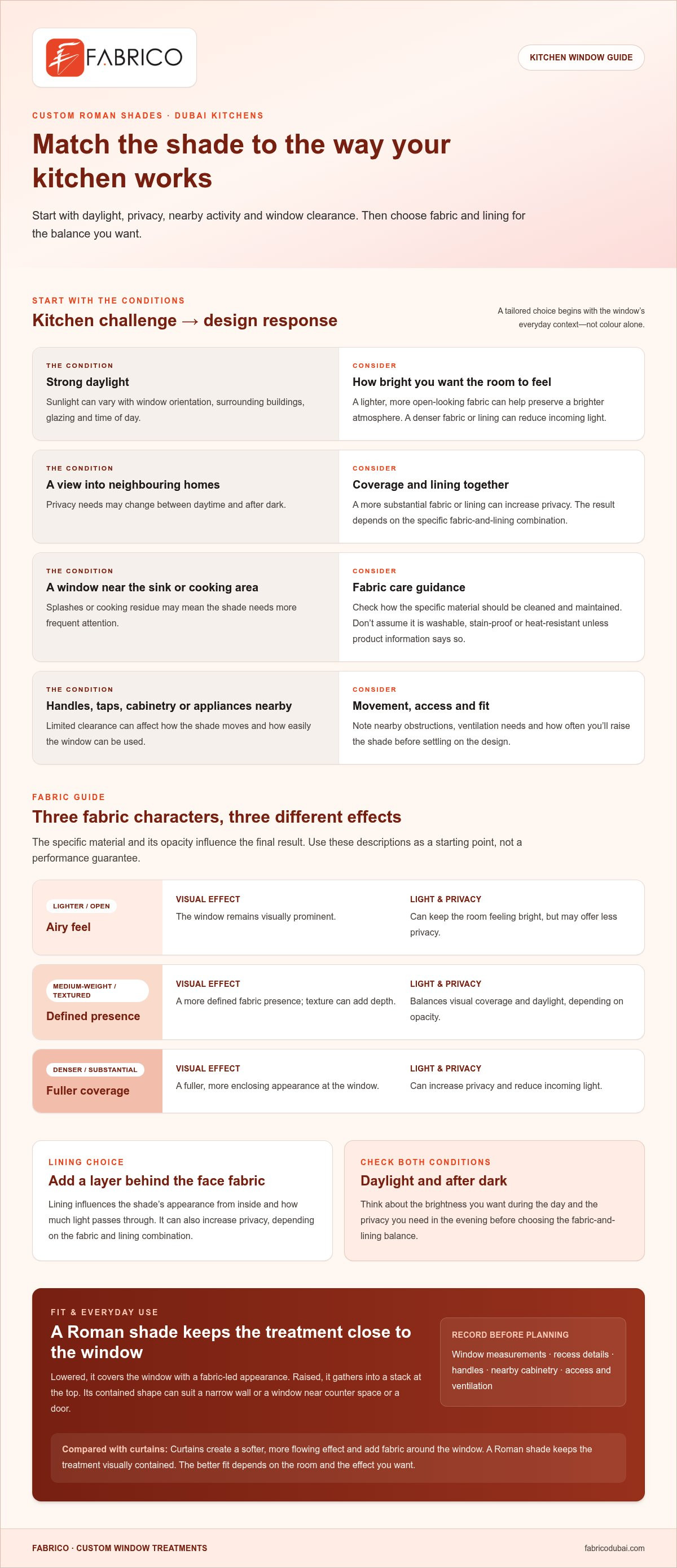
Let the window’s conditions guide your shade selection. Notice how sunlight moves across the window and whether nearby buildings create a direct view into the kitchen. A bright, exposed window may call for a different level of coverage from one that receives softer light or faces a private courtyard. Decide whether you want to retain daylight during meal preparation, gain privacy in the evening, or adjust between the two.
Daily activity matters too. A window beside a sink may get splashed, while one near the cooking area may need more frequent attention because of cooking residue. Consider how often you’ll raise the shade, whether it could interfere with ventilation, and how much clearance it has from taps, handles or appliances. Read the fabric’s care guidance before deciding, since cleaning and maintenance requirements vary by material.
These details help narrow your options before you focus on appearance. Note the window’s orientation, nearby activity and your household’s privacy preferences. With those priorities in view, a custom shade can be planned around the way you use the kitchen.
How fabric, lining and light control affect kitchen Roman shades
Fabric and lining determine how a Roman shade looks at the window and how much light passes through. In Dubai, sunlight varies with a window’s orientation, surrounding buildings, glazing and time of day, so kitchens can need different levels of coverage. Assess the room at the times you use it most, then weigh fabric appearance, privacy and care together.
How should you think about fabric for a kitchen?
Start with how open or covered you want the window to feel. A lighter, more open-looking fabric can preserve a brighter atmosphere, while a denser or more substantial fabric generally gives the window a fuller appearance and more visual coverage. Texture also changes the effect: a smooth surface can look restrained, while a more pronounced weave adds depth. The result depends on the specific material and construction.
Let your kitchen routine guide the practical choice. Consider cooking activity, ventilation and whether the window is close to a sink or food-preparation area. Review the care guidance for the specific fabric, including how it should be cleaned and maintained. Don’t assume a fabric is washable, stain-proof or heat-resistant unless its product information explicitly supports that claim. For a closer look at material considerations, explore this expert guide to Roman blind fabrics in the UAE.
| Fabric character | Typical visual effect | Light and privacy consideration |
|---|---|---|
| Lighter or more open | Airy, with the window remaining visually prominent | Can keep the room feeling bright, but may offer less privacy |
| Medium-weight or textured | A more defined fabric presence | Balances visual coverage and daylight, depending on its opacity |
| Denser or more substantial | Fuller and more enclosing at the window | Can increase privacy and reduce incoming light |
What does a lining change?
A lining adds a layer behind the face fabric, influencing how the shade looks from inside and how much light passes through. It can also increase privacy, though the result depends on the fabric and lining combination. Consider the window in daylight and after dark. A kitchen where you want a bright daytime atmosphere may call for a different balance from one facing neighbouring homes where evening privacy is important.
Use the table as a starting point, not a guarantee of performance. To weigh fabric, lining and the light in your kitchen, a custom Roman shade discussion with Fabrico can help connect your preferences to a tailored window treatment.
Custom Roman shades versus other kitchen window options
The right window treatment depends on the window’s shape, the space around it and how you use the kitchen. A fabric shade can create a tailored finish, while curtains or other blinds may suit a particular layout or operating preference better. When comparing custom Roman shades for kitchen Dubai homes, consider how each option fits, looks and works during everyday routines rather than choosing by appearance alone.
When might a Roman shade work better than curtains?
A Roman shade sits within or around the window area, giving it a compact, fabric-led finish without panels extending across the wall. This can work well where a counter, dining nook or narrow wall leaves little room for curtains to hang freely. Its tailored proportions can also make an unusually sized window feel deliberately finished.
Curtains create a different effect. Their wider panels frame the window and add softness, but they need room to gather when open. A shade also gathers as it rises, so check that its folded position won’t obstruct the top of the glass or interfere with a nearby handle. If you’re weighing the two looks, this guide to American pleated curtains in Dubai offers a broader style comparison.
| Option | Potential advantages | Trade-offs to consider |
|---|---|---|
| Roman shade | Fabric finish tailored to the window; compact appearance when raised | Folded fabric occupies space above the window; needs clearance to operate |
| Curtains | Soft, flowing appearance; can frame a wider area around the window | Panels need room to draw back and may overlap nearby counters or furniture |
| Roller blind | Simple, streamlined appearance with a compact roll | Offers a different, less fabric-folded visual character |
| Slatted blind | Adjustable slats provide a distinct way to manage the view and light | Slats and controls create a different look and require access to operate |
When should you consider a different blind style?
Look beyond the fabric effect if the window opens inward, has prominent handles or sits behind a tap or appliance. These details can affect how easily a shade or blind moves. A roller blind creates a smooth, rolled-up profile, while a slatted blind has a more structured appearance. These are practical and visual distinctions, not guarantees of easier cleaning or longer life.
To narrow your options, note the available wall space, preferred coverage, how often you open the window and whether a gathered fabric finish suits the room. A Roman shade can be a strong fit when its tailored appearance and folded profile work with those conditions. Another treatment may suit the window better if its operating style matches your household routine. Choose for the kitchen you have, not simply the latest trend.
How to plan measurements and details for kitchen Roman shades
A little preparation makes a custom shade discussion more useful. Before planning custom Roman shades for kitchen Dubai homes, look at the window and the surrounding space. A handle, deep sill or worktop can affect where a shade sits and how it moves. Your early notes and photographs help describe the window, but final fitting measurements need to be tailored to the opening and chosen design.
What should you record before discussing a made-to-measure shade?
Begin by noting the window’s width and height at more than one point. Openings can vary slightly, so record each reading and where you took it rather than assuming every edge is level or square. Treat these as planning notes; final dimensions should account for the design and fitting position.
- Note the inside width and height of the recess, plus the frame dimensions.
- Record the sill depth, window handles and how the window opens.
- Mark nearby taps, cabinets, counters or appliances that could obstruct movement.
- Photograph the window straight on and from an angle that shows the surrounding area.
- Write down your preferences for privacy, daylight and the shade’s appearance.
Include details that may seem minor. A handle projecting into the recess, for example, could affect how close a shade sits to the glass. A deep sill may limit the space below it, particularly if the window is above a counter. Photographs show these features in context and make your priorities easier to discuss.
How do mounting position and daily use affect planning?
An inside-recess position places the shade within the window opening for a neat, contained appearance. It depends on the recess providing enough space and clearance around the frame, handles and other fittings. An outside-recess position places the shade beyond the opening and changes how much wall and window area it covers. The window and the finish you want should guide the choice.
Think through your daily routine before settling on a position. Check that the shade can move without catching on a handle, obstructing the window or clashing with items on the sill or counter. Consider where it will sit when raised and whether that position affects the light or view you want.
Share your notes and photographs as a starting point for a tailored project discussion. Fabrico creates custom window treatments, including Roman blinds, in Dubai. Your window details and preferences help shape a design and fitting plan around the individual opening. Discuss a custom kitchen Roman blind with the window’s measurements, photos and priorities ready.
Fabrico custom Roman shades in Dubai: from kitchen brief to finished look
Once you’ve considered how your kitchen window affects light, privacy and everyday use, those priorities can shape a tailored design. Fabrico is a Dubai-based specialist in custom window treatments, including Roman blinds. The process starts with the particular window and the way your household uses the kitchen, rather than treating the shade as a standard furnishing.
Your notes don’t need to be a complete technical specification. Measurements and photographs provide a useful starting point, while your preferences clarify what the finished treatment should do and how it should look. For custom Roman shades for kitchen Dubai homes, a made-to-measure approach brings these details together so appearance and practical use inform the same design conversation.
What can a tailored Roman blind discussion address?
A useful brief brings together the window’s dimensions, preferred mounting position and surrounding layout. Describe the fabric appearance you like, how much daylight you’d like to retain and the level of privacy you want at different times. These preferences may need balancing. For example, you might want softly filtered daylight while also prioritising evening privacy.
The kitchen provides important context. A window above a counter has different clearance considerations from one beside an open wall, and nearby handles or cabinetry may affect how the shade sits or moves. Sharing photographs alongside your notes shows these relationships. The design can then respond to the actual opening and room, rather than relying on assumptions about what every kitchen needs.
How to take the next step with Fabrico
Bring together your initial measurements, photographs and a short list of priorities. Note whether you prefer a contained, tailored appearance or a more prominent fabric feature, along with any concerns about privacy, brightness or window access. If you’re unsure which preference should take precedence, describe the trade-off. A focused discussion can help clarify what matters most before the design is settled.
Fabrico’s custom Roman blind service considers the treatment in relation to your individual window and kitchen brief. The discussion can cover practical and aesthetic needs, from the room’s layout to the finish you have in mind, before settling on a fabric or fitting approach. This creates a clear route from your initial idea to a design shaped around your home.
When you’re ready, discuss custom Roman shades for your kitchen with Fabrico and share the window details and look you’re hoping to achieve.
Shape a Kitchen Window Treatment Around Your Routine
Notice how your kitchen feels at different times: during meal preparation, as daylight shifts and after dark. This can help you decide which quality matters most in your space, whether that’s a brighter feel, more privacy or a fabric finish that sits naturally with the room.
Keep a short note of your preferences and the details that make your window distinctive. You don’t need every decision settled before exploring custom Roman shades for kitchen Dubai homes. A clear starting point makes it easier to develop a design that feels considered and works with the way you live.
Fabrico creates custom Roman blinds for kitchen windows in Dubai. Discuss custom Roman shades for your kitchen and take the next step towards a window treatment that feels right at home.
Frequently Asked Questions
Can Roman shades be fitted to a kitchen window with handles?
Yes, Roman shades can be designed around window handles, provided the fitting allows suitable clearance and the window remains practical to operate. Note each handle’s position and how far it projects, as well as whether the window opens inward or outward. A handle within the recess can affect the available fitting space. Clear photographs and approximate dimensions help make the design discussion specific to your kitchen window.
Are Roman shades suitable for a kitchen window above a sink?
They can be considered above a sink, but the distance from the tap and the likelihood of splashes or steam should inform the choice. Think about how frequently the sink is used and whether you would raise the shade while washing or preparing food. Review the care guidance for the selected fabric before deciding. The window’s position and your usual kitchen routine can help shape a practical design.
Can custom Roman shades be made for a bay window in Dubai?
A bay window can be considered for a custom Roman blind design, though its separate sections and angles need to be understood as a whole. Make a simple sketch showing where each frame meets, and note the approximate width and height of each section. Include photos taken from inside the room. This context helps relate the shade design to the bay’s shape, available space and preferred overall appearance.
Should kitchen Roman shades be fitted inside or outside the window recess?
Either position may suit a kitchen, depending on the recess depth, frame, handles and the look you prefer. An inside fit follows the opening, while an outside position extends beyond it. Before deciding, consider how each option relates to the sill, nearby counter and anything that needs to remain accessible. The window’s measurements and clearances should guide the design rather than a standard rule.
How should I clean kitchen Roman shades?
Follow the care instructions for the chosen fabric, since cleaning methods vary between materials. Don’t assume a shade can be machine-washed or treated with household cleaners. In a kitchen, check the fabric periodically for dust or cooking residue and follow its care guidance. Avoid cleaning products unless the instructions say they’re suitable, as an unsuitable method may affect the fabric.
Can Roman shades provide privacy without making a kitchen too dark?
Yes, the balance can be tailored, but it depends on the fabric’s opacity, any lining and the light reaching your particular window. Consider daytime and evening separately: daylight may make a window feel private during the day, while interior lighting can change the view after dark. For custom Roman shades for kitchen Dubai homes, describe both situations so privacy and brightness can be considered together.
What should I prepare before requesting custom kitchen Roman shades?
Prepare approximate window width and height, recess depth, and notes about handles, the sill and nearby counters. Add clear photographs, including one that shows the surrounding kitchen, and note your preferred level of daylight and privacy. Fabric or colour references can help communicate the look you have in mind. These details give Fabrico a useful starting point for discussing a made-to-measure Roman blind for your Dubai kitchen.