
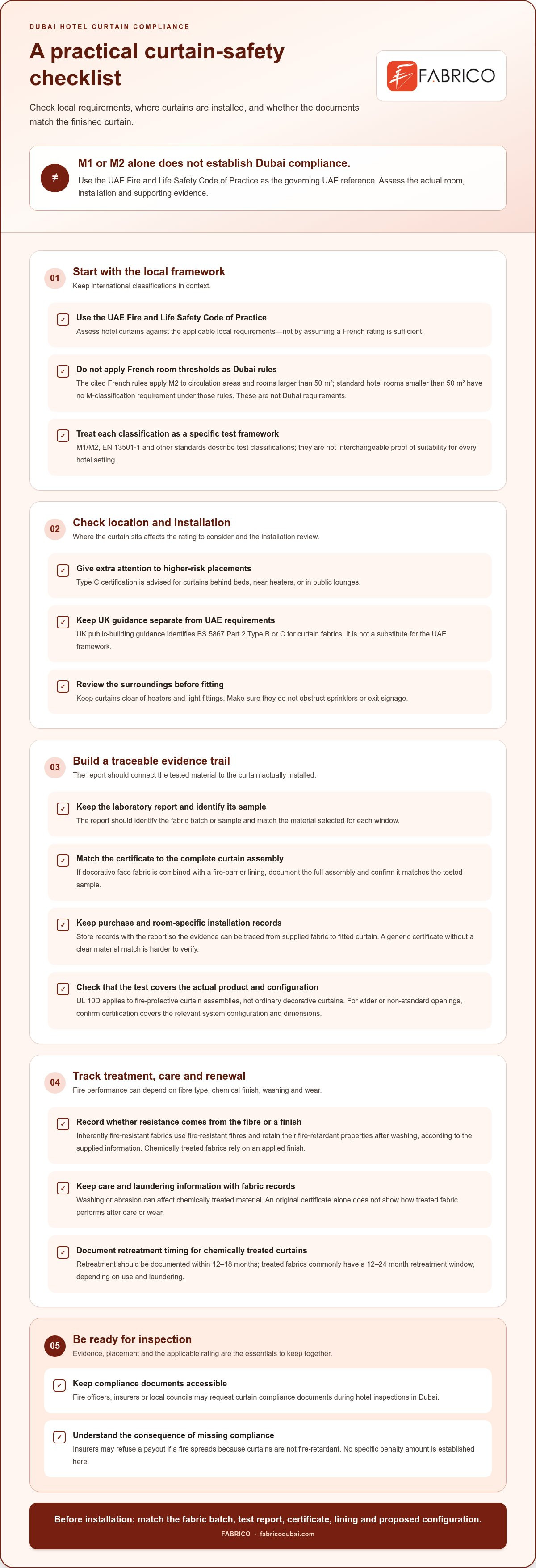
An M1 or M2 label alone does not answer whether hotel curtains meet fire safety compliance requirements in Dubai. The relevant UAE reference is the UAE Fire and Life Safety Code of Practice, so fire safety compliance for hotel curtains in Dubai should be assessed against the applicable local requirements, not assumed from a French classification. Civil Defence approval is a separate consideration for fire-safety products and systems, including certain fire curtain applications.
It’s understandable to look for a clear rating before choosing fabric, but the fabric’s fire performance, any chemical treatment and the documentation for the finished curtain assembly all matter. This guide explains how those factors relate to compliance, what M1 and M2 do and don’t tell you in Dubai, and where Civil Defence approval fits. It also clarifies the difference between decorative hotel curtains and engineered fire curtain systems, so you can approach the requirement with greater confidence.
Key Takeaways
- Understand why an M1 or M2 rating alone doesn’t establish compliance for hotel curtains in Dubai, and which local fire-safety framework is relevant.
- Learn what test reports and records help connect a curtain’s fabric performance to the finished installation.
- Compare inherently fire-resistant fibres with chemical treatments, including how washing and fabric care can affect performance.
- See how Civil Defence approval relates to regulated fire-safety products, and where Fabrico’s custom curtains and fire-retardant treatment fit into a hotel project.
Dubai fire and life safety requirements for hotel curtains
The UAE Fire and Life Safety Code of Practice is the governing UAE reference. For hotel curtains, distinguish its local requirements from M1 and M2 classifications used elsewhere.
Curtain Requirements by Room Area
Room area can affect curtain rules in other countries, but it does not establish a Dubai M1 or M2 threshold. In France, M2 applies to circulation areas and rooms larger than 50 m²; standard hotel rooms smaller than 50 m² have no M-classification requirement under the cited rules. Those French thresholds aren’t Dubai requirements. For Dubai buildings, use the UAE framework and assess the actual room and installation.
Fire Ratings by Curtain Location
A curtain’s location affects the fire-safety rating to consider. Type C certification is advised for curtains behind beds, near heaters, or in public lounges. UK public-building guidance identifies BS 5867 Part 2 Type B or C for curtain fabrics, but that standard isn’t a substitute for UAE requirements. Keep curtains clear of heaters and light fittings, and ensure they don’t obstruct sprinklers or exit signage.
Fire-Test Records and Treatment Renewal
Fire-test documentation should connect the tested material to the installed curtain. Keep a laboratory report identifying the fabric batch or sample, plus purchase and installation records. If decorative face fabric combines with a fire-barrier lining, document the complete assembly and match it to the tested sample. Chemically treated curtains should have retreatment documented within 12-18 months; treated fabrics commonly have a 12 to 24 months retreatment window, depending on use and laundering.
Inspections and Non-Compliance Risks
Fire officers, insurers or local councils may request curtain compliance documents during hotel inspections in Dubai. Before installation, compare the test report with the selected fabric and complete curtain assembly, then keep room-specific installation records. Non-compliance can have serious consequences: insurers may refuse a payout if a fire spreads because curtains are not fire-retardant. Since no specific penalty amount is established here, focus your checklist on evidence, placement and the applicable rating.
What Makes a Curtain Fire Retardant?
A curtain’s fire performance is established through testing, not appearance or a fabric label alone. BS 5867 Part 2 addresses curtain performance in public and commercial buildings, while NFPA 701 is a textile flame-test standard referenced for Dubai commercial projects. These standards describe different testing frameworks. Assessing fire safety compliance for hotel curtains in Dubai means identifying the standard used and the material tested, rather than treating every certificate as interchangeable.
A laboratory report should identify the tested fabric sample or batch and link it to the material selected for each window. Keep the certificate with purchase and installation records so the evidence can be traced from supply to fitting. A generic certificate with no clear match to the fabric makes it harder to show that the correct material was tested and to support fire safety compliance for hotel curtains in Dubai.
Compliance documents should describe the tested product and its limits, rather than relying on the words “fire retardant” alone. If decorative face fabric is combined with a fire-barrier lining, document the complete assembly and confirm that it matches the tested sample. This matters because combining components can affect the finished curtain’s performance and how fire may spread.
UL 10D applies to fire-protective curtain assemblies, not ordinary decorative curtains. For wider or non-standard openings, system certification should cover the relevant single or multiple roller orientation and oversized dimensions. A report for a standard opening doesn’t establish performance for a larger installation; the certified configuration needs to correspond to the actual opening and system.
Before installation, compare the fabric batch, laboratory report, certificate, lining and proposed configuration. This records check helps distinguish a tested curtain fabric from a complete, tested assembly. Where fabric needs added protection, a fire-retardant treatment may be relevant; keep treatment records associated with the material and its supporting test documentation.
Inherently fire-resistant and chemically treated fabrics
Fabric selection affects curtain fire performance during washing and everyday use. The key distinction is whether resistance comes from the fibres or a chemical finish.
Fabric Testing and Classifications
Fire classifications describe a material’s reaction to fire under a specified test, not its suitability for every hotel setting. EN 13501-1, for example, includes classes such as B s1 d0. French M1 to M4 classifications use technical criteria described in NF P 92-507, dated February 2004. These systems help interpret test results, but an M1 or M2 label alone does not establish Dubai compliance. Match the classification and test evidence to the intended fabric and use.
Flame-Retardant Styles and Finishes
A flame-retardant finish is applied to fabric to reduce fire risk, while weave, colour and drape remain design considerations. For a hotel, balance the desired finish with the fabric’s care requirements and tested classification. Washing or abrasion can affect chemically treated material, so its original certificate alone cannot show how it performs after care or wear. Keep treatment and laundering information with the fabric records.
Types of Fire-Retardant Fabric
The two broad types are inherently fire-retardant fabric and fabric treated with a chemical finish. Inherently resistant curtains use fire-resistant fibres and retain their fire-retardant properties after washing, according to the supplied information. Chemically treated curtains may need additional care because washing or abrasion can affect their fire-retardant performance. Non-durable fire-retardant curtains are described as suitable only for single-use or dry-cleaned applications. These differences matter for occupancy patterns and housekeeping: frequent laundering makes the care method central to fabric selection. Record the material type and care process so staff can preserve tested performance throughout the curtain’s service life.
Dubai Civil Defence approval for fire-safety products
Dubai Civil Defence approval applies to regulated fire-safety products and systems, not simply to a curtain’s fabric rating. This distinction matters because decorative curtains and engineered fire curtains serve different purposes.
Accepted Standards and Certifications
For hotel curtain fabrics, BS 5867 Part 2 and NFPA 701 are standards referenced for commercial projects; neither should be treated as blanket Civil Defence approval. A fabric test addresses the material’s fire performance, while approval requirements may apply separately to specific products or systems. Dubai Civil Defence may require additional approvals for fire curtain installation and testing, so identify whether the project involves decorative furnishing or an engineered fire curtain system.
Certified Curtain Suppliers in Dubai
For hotel curtains, choose a supplier that can provide documentation linking the supplied fabric to its test evidence. Records should identify the tested sample or batch and match the fabric selected for the hotel spaces. If a curtain combines face fabric and lining, the documentation should cover the complete tested assembly, not just one component.
For regulated fire-safety products, Dubai Civil Defence approval requirements depend on the specific product and application. Trading in equipment necessary for Civil Defence operations requires approval from Dubai Civil Defence General Command. A fire curtain trading licence alone does not necessarily authorize installation or maintenance; separate licensing or Civil Defence registration may apply. Cleaning and laundering also matter for chemically treated curtains because they can affect treatment performance.
Before installation, distinguish a certified fabric from an approved fire-safety system, then align the supplier’s documents with the intended use. For a curtain project, discuss your curtain requirements and the fabric protection considerations relevant to the space.
Fabrico: Pleated American curtains
Fabrico provides Pleated American curtains for hotel spaces where tailored window treatments need to complement the room’s finish. For a hospitality project, style is only one part of the decision: the selected fabric and its fire-test documentation must also suit the intended use.
Bring room requirements and fabric documentation together early, so the curtain choice supports both the desired appearance and the project’s compliance process. Fabrico also provides Roman blinds for windows where a different treatment format is preferred. Hotels coordinating several soft-furnishing needs can also consider Sofa and Chair Upholstery and Outdoor Protection Covers.
Contact Fabrico to discuss your curtain requirements, or visit fabricodubai.com.
Plan the next curtain decision with confidence
Make fire safety compliance for hotel curtains in Dubai part of project planning from the outset. Connect the intended room finish with fabric selection, care requirements and the documentation needed for each installation. Keeping these decisions together helps teams coordinate procurement and room preparation without treating a fabric label as the whole compliance process.
Fabrico offers Pleated American curtains and Roman blinds for window treatments, as well as Sofa and Chair Upholstery for furnishing projects. These services can support a broader room refresh, while fire performance remains a separate technical requirement backed by relevant test documentation.
Share your project requirements with Fabrico to discuss curtain options for your hotel. Contact Fabrico about compliant curtains, and take the next step toward a carefully considered guest-room finish.
Frequently Asked Questions
Do hotel rooms need M1 or M2 curtains?
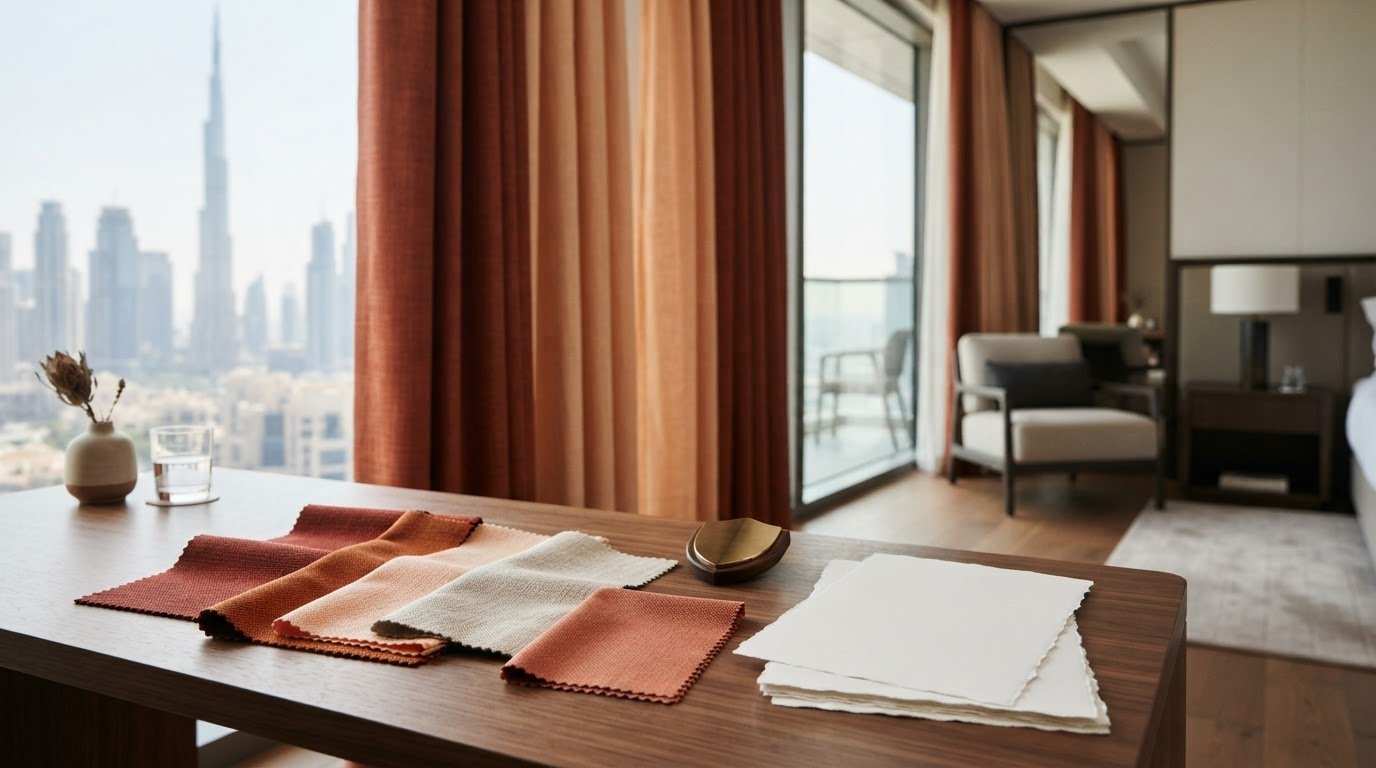
Dubai hotel rooms don’t have a blanket M1 or M2 curtain requirement established by the information discussed here. M1 and M2 are French fire classifications, so don’t treat either label as a substitute for the UAE fire-safety framework. For example, a project team comparing fabric samples should record the actual test standard and evidence, rather than selecting a curtain based only on an M-rating.
How do you prepare for the safety commission inspection?
Prepare a room-by-room file linking curtain records with the hotel’s wider fire-safety documents. Keep test certificates, maintenance reports, drill records, training attendance records and the approved maintenance contract together for inspections and hotel licence renewal. After refurbishment, ensure displayed evacuation plans match the current layout. Update the room or floor file whenever curtain installation details change.
What Dubai Civil Defence fire safety rules apply to hotel curtains?
Hotel curtain decisions in Dubai sit within the UAE Fire and Life Safety Code of Practice, while Civil Defence approval may separately apply to regulated fire-safety products and systems. Do not confuse decorative curtains with engineered fire curtains. For a hotel project, assess the product’s intended role, installation and supporting documents. Trading in equipment necessary for Civil Defence operations requires Dubai Civil Defence General Command approval.
Do Dubai hotel curtains need flame-retardant treatment or inherently flame-retardant fabric?
Either fabric type may be suitable, depending on its tested performance and the hotel’s care routine. Inherently fire-resistant fibres retain their fire-retardant properties after washing, while chemically treated curtains need retreatment after washing. A hotel with frequent laundering should account for its cleaning process when choosing fabric and maintaining records, rather than relying on the initial selection alone.
What fire test certificates and documents must hotels provide for curtains in Dubai?
Keep the laboratory test report, certificate, fabric batch or sample identification, and purchase and installation records available. For curtains made from decorative face fabric and fire-barrier lining, retain documentation for the complete assembly. These records let an inspector trace the installed material to its test evidence. Organising them by room or installation area makes the right file easier to retrieve during an inspection.