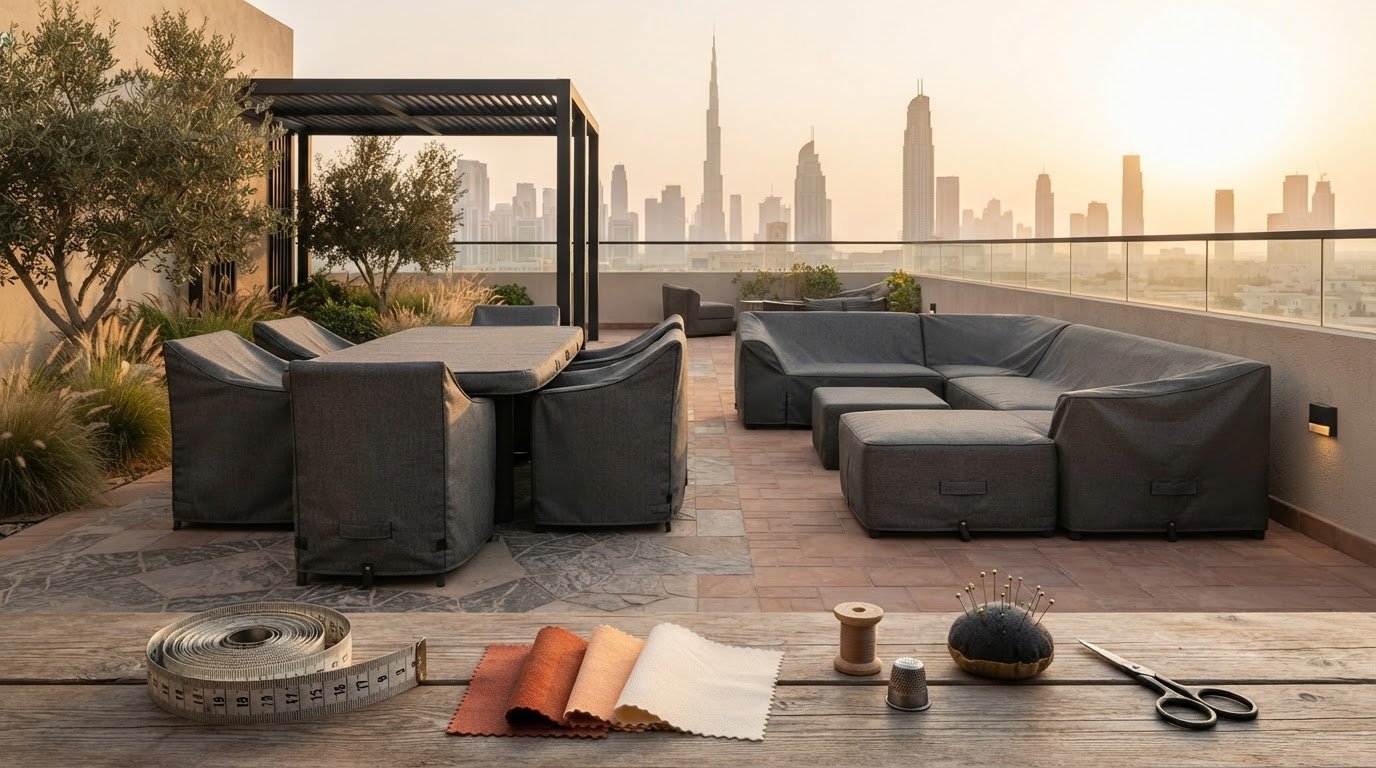

A custom-fit protective cover for patio furniture should match the furniture’s dimensions, shape and outdoor conditions, not just its overall length and width. For easier fitting and removal, allow approximately 1.5 cm for each dimension. The right material and fastening approach also depend on where the furniture sits and how the cover will be used.
A close fit helps protect furniture while keeping the cover practical to put on and take off. This guide explains what to consider when choosing outdoor-cover materials, how to measure furniture, and how to account for chair backs and other protruding parts. It also covers openings, vents and lower-edge fastening, and how a custom-made cover can fit an individual item or dining set rather than simply draping over it.
Key Takeaways
- Choose a cover around the furniture’s shape and outdoor setting, not just its general size.
- Include chair backs, arms, and other protruding parts when planning the cover’s dimensions.
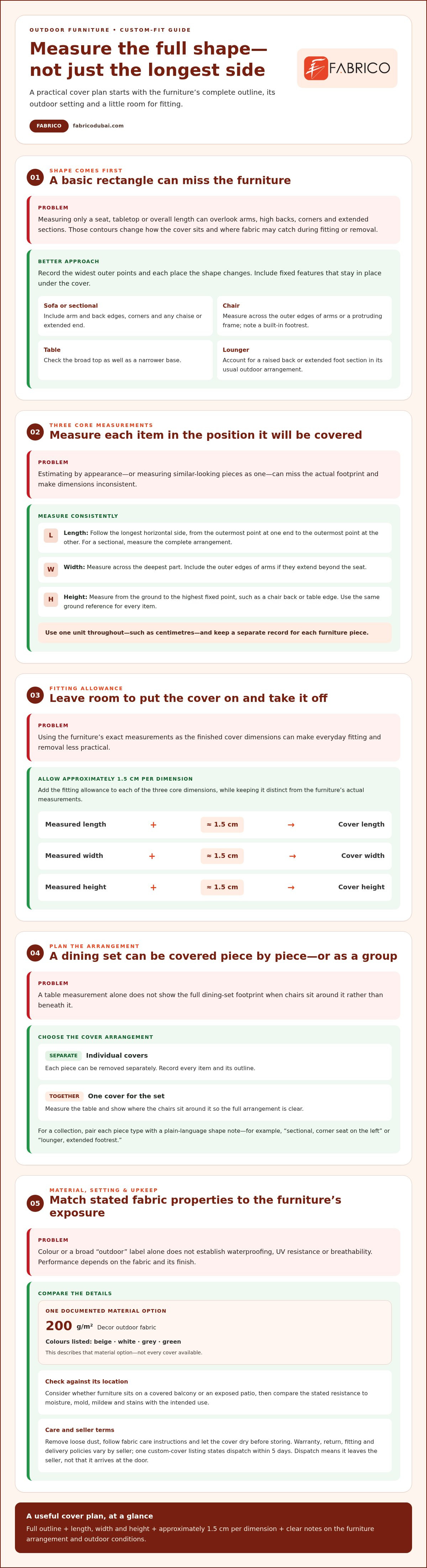
- Measure length, width, and height using one consistent unit, and allow approximately 1.5 cm per dimension for easier fitting and removal.
- For a dining set, show how the chairs sit around the table so the cover can account for the full arrangement.
- Consider vents, openings, and lower-edge fastening alongside the cover material to support practical use outdoors.
Why Should I Use Custom Covers for My Outdoor Furniture and Equipment?
Custom covers suit outdoor furniture whose shape or arrangement makes a general cover awkward. Material, fit, fastening and care all affect how practical the finished cover will be.
Furniture Types Covered
Made-to-measure covers can be shaped for sofas, sectionals, dining sets, individual chairs and other outdoor furniture. The key is the item’s outline: a sectional has joined seating and corners, while dining chairs may sit around rather than beneath a table. Decide whether separate pieces need individual covers or one cover should fit the complete arrangement.
For each piece, note features that affect its outline, such as broad arms, high backs or a table base. Custom fit protective covers for patio furniture are especially useful when these details affect the cover’s shape and everyday handling.
Made-to-Measure Cover Service
A made-to-measure cover is planned around the furniture’s dimensions and arrangement. For a dining set, individual covers can be removed separately, while one cover may suit the set as a group. Choose the arrangement that best fits how you use and store the furniture.
Delivery timing depends on the seller and order; one custom-made cover listing states dispatch within 5 days. Dispatch means the order leaves the seller, not that it arrives at the door. UAE retailers and specialist makers provide made-to-measure options, with service details differing between businesses.
Fabric and Material Choices
Compare outdoor cover fabric by its stated properties, weight and care requirements rather than colour alone. One documented option uses Decor outdoor fabric weighing 200 g/m², in beige, white, grey and green. These details describe that material option, not every cover available in the UAE.
Outdoor covers may be described as resisting mold, mildew, stains and moisture. Use those stated properties to guide material selection, but match the fabric description to the conditions around your furniture. Consider whether it sits on a covered balcony or an exposed patio, and what the cover is intended to do.
Cover Performance and Care
Waterproofing, UV resistance and breathability depend on a cover’s fabric and finish. Compare the stated properties with the furniture’s outdoor exposure rather than assuming a universal performance level. For care, remove loose dust, follow the fabric’s care instructions and let the cover dry before storing it.
Warranty, return and fitting policies vary by seller in the UAE. Custom dimensions and fitting arrangements may affect the terms, so review the written warranty, delivery arrangements and fabric specifications as part of the order.
Accounting for chair backs, arms, and protruding parts
Measure the full outline of each item, not just its seat or tabletop. Include chair backs, arms and other protruding parts in custom-cover measurements. For example, a chair with wide arms needs a different cover shape from a narrow, armless chair, even if their seats are similar. These contours affect how the cover sits and where fabric may catch during fitting or removal.
For a sofa or sectional, note the outer edges of the arms and backrest, along with any corner or chaise section. A straight sofa has a simpler outline than a sectional with an extended end. Record the widest points and where the shape changes, then describe these clearly in the cover plan. This distinguishes the furniture’s actual footprint from a basic rectangle.
Chairs vary in profile. A dining chair with a tall back, a chair with curved arms and a compact side chair each have different contours. Measure from the widest outer point on one side to the widest point on the other. Include fixed details that remain in place when covering the chair, such as a protruding frame or built-in footrest.
Tables and loungers need their own outline checks. A table may have a broad top over a narrower base, while a lounge chair may extend well beyond its backrest when arranged for use. Note whether the lounger has a raised back or extended foot section when stored. A cover planned only around its folded position may not fit its usual outdoor arrangement.
Use a short item-by-item record for a collection of outdoor furniture. Write each piece’s type, overall shape, and protruding features together, such as “sectional, corner seat on the left” or “lounger, extended footrest.” This makes the cover plan more specific than a generic label and helps avoid overlooked contours. A durable fabric still needs a shape that follows the furniture without snagging on arms or corners. For tailored cover options, review outdoor protection covers alongside the furniture’s outline.
Measuring furniture for a cover
Start with three core measurements: length, width and height. Use one unit throughout, such as centimetres, and measure the furniture in the position it will occupy under the cover. For custom fit protective covers for patio furniture, consistent measurements and a clear outline are more useful than estimates based on appearance. Record each item separately, even when several chairs look alike.
- Measure length. Follow the longest horizontal side, from the outermost point at one end to the outermost point at the other. For a sectional, include the complete arrangement rather than measuring only one seating section.
- Measure width. Record the distance across the deepest part of the furniture. A chair with arms may be wider than its seat, so include the outer edges of the arms.
- Measure height. Measure from the ground to the highest fixed point, such as a chair back or table edge. Use the same ground reference for every item.
- Allow fitting room. Add approximately 1.5 cm for each dimension to make fitting and removal easier. Keep this allowance distinct from the furniture’s actual measurements.
For a patio dining set, measure the table and show where the chairs sit around it. For example, note which sides have chairs and whether any chair extends beyond a table corner. The arrangement affects the cover’s footprint, so a simple sketch can make the layout clearer than a list of dimensions alone.
Record changes in shape. Mark a chaise end, curved arm, raised back or wide table base on a sketch, then label each feature with its measurement. If the furniture has removable cushions or an adjustable position, specify the configuration the cover should fit. A cover planned for a reclined lounger may not suit the same chair upright.
Organize the details before requesting a quote. Label each item, such as “left lounge chair” or “dining table,” and pair the label with its length, width and height. Add clear photos from the front, side and above, showing the whole item. Include a ruler or tape measure only when it does not obscure an edge.
State where the furniture sits and what weather reaches it. An exposed patio and a sheltered balcony present different conditions. If waterproof performance matters, note that requirement alongside the measurements and compare it with the fabric’s stated properties. Keeping the sketch, photos and dimensions together helps prevent confusion when several pieces need covers.
Considering vents, handles, openings, and lower-edge fastening
Plan openings and fastening details around the furniture’s location and exposure. A cover for a table against a wall may need a different access point from one on an open patio. Before finalizing the shape, mark vents, handles, gaps and fastening positions on a simple sketch.
First, identify what each feature needs to do. A handle may need to remain accessible for moving a covered item, while an opening may allow a fixed component to pass through. Note the feature’s position in relation to the cover’s edges, and specify whether it needs a slit, flap or another shaped opening. For example, mark a handle on the left edge rather than writing only “handle.”
Plan vent placement deliberately. Mark the intended position on the cover plan and consider how the furniture sits outdoors, including whether a wall or nearby structure blocks one side. Vents should be part of the design, not added randomly after fitting. The material, lower edge and securing method should also suit the placement and surrounding conditions.
Choose a lower-edge finish based on how the cover will sit and be secured. Options include a hem, rope in a tunnel or eyelets. A hem gives the edge a finished form, a rope in a tunnel creates a continuous channel, and eyelets provide fastening points. Match the finish to the furniture’s shape and how you plan to secure the cover.
- Hem: Consider this finish when a neat, finished edge is the priority.
- Rope in a tunnel: Consider how a continuous rope can follow the base of the furniture.
- Eyelets: Mark where fastening points should align with the furniture or its support area.
Avoid placing an eyelet somewhere difficult to reach, such as behind a sofa arm pressed against a wall. For a table cover, check that the lower edge can be secured without interfering with the legs. When comparing polyester with another fabric, consider the material description alongside the opening and fastening plan. The word “polyester” alone does not establish how the finished cover will perform.
After fitting, check that the cover stays in place and does not trap standing water. A slight slope is recommended for a protected item with a flat top, helping rainwater run off. Do not leave standing water on the cover for long periods. When practical, remove the cover to inspect the furniture and clear any water collected on top.
Custom-fit covers for patio furniture
In the UAE, custom-made covers are available for individual outdoor furniture pieces and complete arrangements. A documented option uses Decor outdoor fabric weighing 200 g/m², with beige, white, grey and green colour choices.
The main benefit is a cover shaped for the item rather than chosen from a general size range. That matters for a compact chair, a long sectional or a dining set whose chairs extend beyond the table. Individual covers also let you remove each patio furniture cover separately, making access easier when you use only part of the arrangement.
Dimensions need to fit the product’s actual size range. Product data lists minimum and maximum cover lengths of 0.5 and 4.0, and minimum and maximum cover widths of 0.5 and 4.0. For side one, the listed minimum is 0.3 and maximum is 2.0. These figures are listed without a unit, so treat them as product data values rather than assuming a measurement unit.
Before settling on a custom-fit order, work through these choices:
- Cover arrangement: Choose separate covers for pieces you move or use independently, such as dining chairs and a table.
- Shape: Identify the furniture outline and any side or component that needs its own cover dimension.
- Fabric and colour: Compare the stated material properties with the furniture’s location, then select from available colours.
- Top design: A slight slope is recommended for a protected item with a flat top, helping rainwater run off.
The word “resistant” needs context. An outdoor cover may be described as resisting mold, mildew, stains and moisture, but that does not guarantee waterproofing or performance in every weather condition. Compare stated properties with the furniture’s exposure, and avoid leaving standing water on the cover for long periods.
Custom sizing also has practical limits. The listed length and width values span 0.5 to 4.0, while side one spans 0.3 to 2.0. Match each furniture piece to the relevant dimensions before choosing an arrangement. Custom-made covers are listed for dispatch within 5 days, which describes dispatch timing, not delivery to your address.
For a considered fit, bring together the furniture dimensions, its shape and the intended cover arrangement. Explore custom outdoor protection covers for a tailored covering solution.
Use that rate to consider the cover’s area alongside its dimensions and arrangement. This gives you a per-area price point to weigh when deciding which pieces need individual coverage and how much material the chosen fit requires.
Fabrico: Pleated American curtains
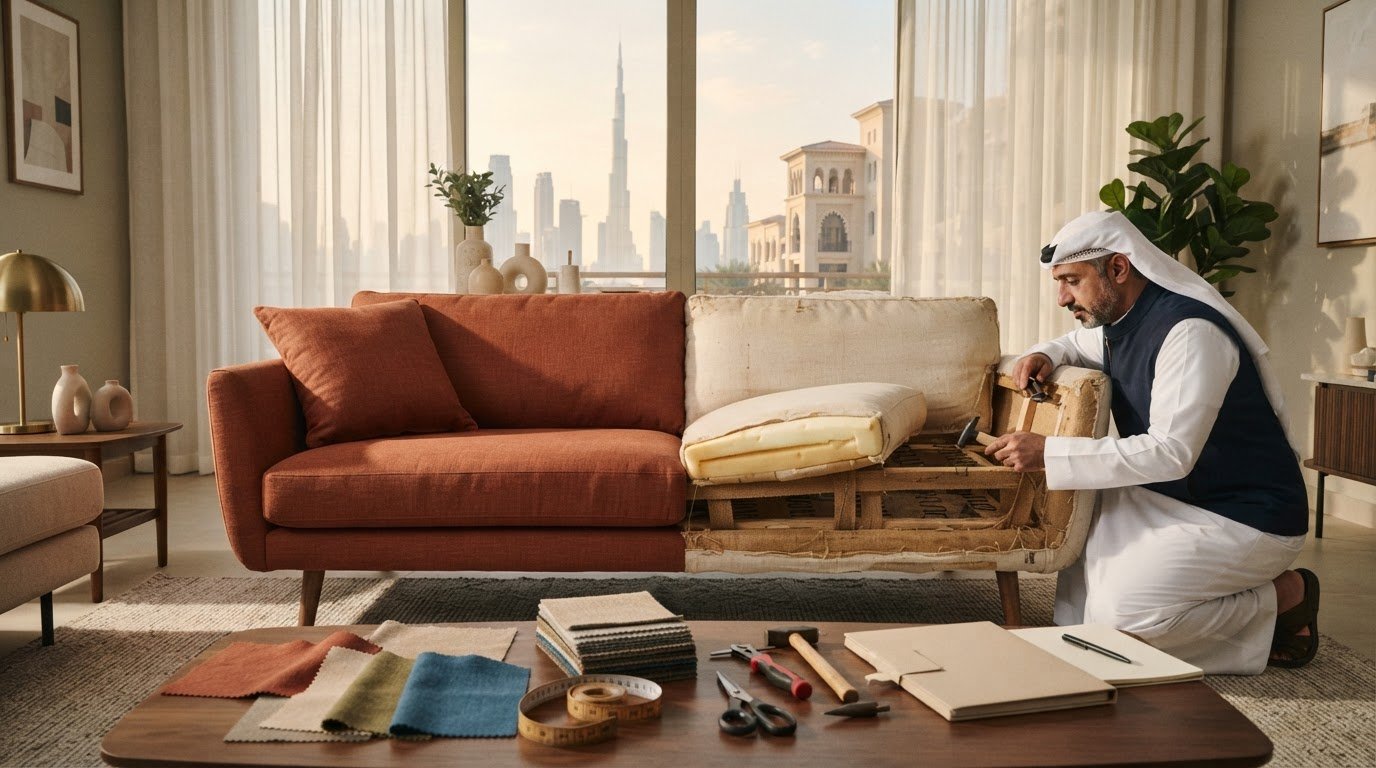
If your outdoor furniture needs a tailored solution rather than a standard cover, Fabrico offers Outdoor Protection Covers in Dubai. Fabrico also provides Sofa and Chair Upholstery for outdoor seating that needs renewed fabric.
For indoor spaces, Fabrico also provides Pleated American curtains and Roman blinds. These suit different window-treatment needs, while outdoor covers and upholstery meet distinct practical requirements. When discussing a cover, share the furniture’s shape, measurements and intended placement so these details can guide the conversation.
Contact Fabrico to discuss an outdoor cover or upholstery for your furniture.
Prepare Your Outdoor Space for the Seasons Ahead
The right cover starts with how you use your patio, not just how the furniture looks uncovered. Consider which pieces stay outside, which you move often and how much access you need between uses. This helps you choose custom fit protective covers for patio furniture that suit your routine as well as the furniture’s shape.
Before settling on a solution, consider how your outdoor area changes through the year. A dining set used regularly may need a different arrangement from seating kept in a quiet corner. Choose a cover that supports how you use the space, rather than making everyday access harder.
For a broader home refresh, Fabrico also provides Sofa and Chair Upholstery, Pleated American curtains and Roman blinds. These services meet separate needs, from renewing seating to tailoring window treatments, with attention to function and finish.
If your outdoor seating needs protection, share its dimensions and intended placement with Fabrico. Contact Fabrico about custom covers and take the next step toward a thoughtfully prepared outdoor space.
Frequently Asked Questions
What Materials Are Available for Custom Covers?
A documented option is Decor outdoor fabric weighing 200 g/m², available in beige, white, grey and green. Its stated resistance includes mold, mildew, stains and moisture. Those properties describe this fabric option, not every outdoor cover material. Compare the stated fabric composition and performance details with the conditions around your furniture, rather than choosing by colour or weight alone.
How do I measure patio furniture for a custom cover?
Measure the furniture in the position you want covered, then record its overall length, width and height. Include details that change its outline, such as a chaise extension or a table base wider than its legs. For a dining set, show the chair layout in a sketch. Label the photos and measurements by item so similar-looking pieces do not get mixed up.
What materials are best for custom outdoor furniture covers in hot, sunny climates?
Choose a fabric whose product details specify its suitability for outdoor exposure, including any stated UV resistance and breathability. Weight alone does not establish either property. For a sunny Dubai terrace, compare those specifications with the furniture’s exposure and the cover’s intended use. The available material description for Decor outdoor fabric gives its weight and resistance properties, but does not specify a UV rating or airflow.
How long does it take to order and receive a custom patio furniture cover in the UAE?
One custom-made outdoor cover listing states dispatch within 5 days. Dispatch is when the order leaves the seller, not when it reaches your UAE address. Delivery follows separately, with transit affected by the destination and shipping arrangements. Keep the dispatch estimate and delivery estimate distinct when planning around an event, travel date or seasonal change.
What features should I compare, such as vents, drawstrings, zippers, and straps?
Assess each feature by its purpose and position on the furniture. Vents are a design consideration, while zippers, straps and drawstrings affect access or fastening. Listed lower-edge finishes include a hem, rope in a tunnel and eyelets. For a chair beside a wall, note whether fastenings will remain reachable; for a table, consider how the edge will sit around its legs.
Can custom covers protect patio furniture from UAE dust, sand, rain, and extreme heat?
A fitted cover creates a physical barrier between furniture and outdoor exposure, including dust and sand. The material’s stated moisture resistance can help guide rain protection, but it does not necessarily mean the cover is fully waterproof. Check the fabric’s stated suitability for extreme heat rather than assuming it will protect against it. For a flat-topped item, a slight slope helps rainwater run off, and standing water should not remain on the cover for long.