
What if a fabric treatment that sounds reassuring hasn’t been tested for the textile or use you have in mind? Choosing fire safety fabric treatment UAE customers can rely on means looking beyond the label: treated fabric isn’t necessarily fireproof, and suitability depends on the material, application and supporting evidence. Before treating curtains or upholstery, it’s sensible to get clear answers about appearance, feel and care instructions.
This guide explains what fire-retardant treatment can and can’t do, how it differs from fabric manufactured with fire-resistant properties, and what to ask about test reports, certificates and applicable standards. You’ll also learn what to check about fabric compatibility, cleaning and possible re-treatment, and how to assess a provider. We include practical questions for UAE buyers and introduce Fabrico, a Dubai-based specialist offering fire-retardant treatment alongside curtain and upholstery services. The aim is to help you match evidence to your fabric and its intended use, rather than rely on broad claims.
Key Takeaways
- Assess the textile’s fibre, weave, backing, lining and condition before deciding whether treatment may be suitable.
- For fire safety fabric treatment UAE, request evidence that identifies the textile or treated assembly, intended use and test basis.
- Compare the documents provided with the project’s requirements. Provider credentials alone don’t demonstrate how a specific fabric performs.
- Prepare fibre labels, product details, photos and relevant project specifications to support a clearer assessment.
- Before proceeding, ask about care instructions and possible effects on appearance or feel. Compare providers on scope, evidence and communication.
What fire-safety fabric treatment means for UAE curtains and upholstery
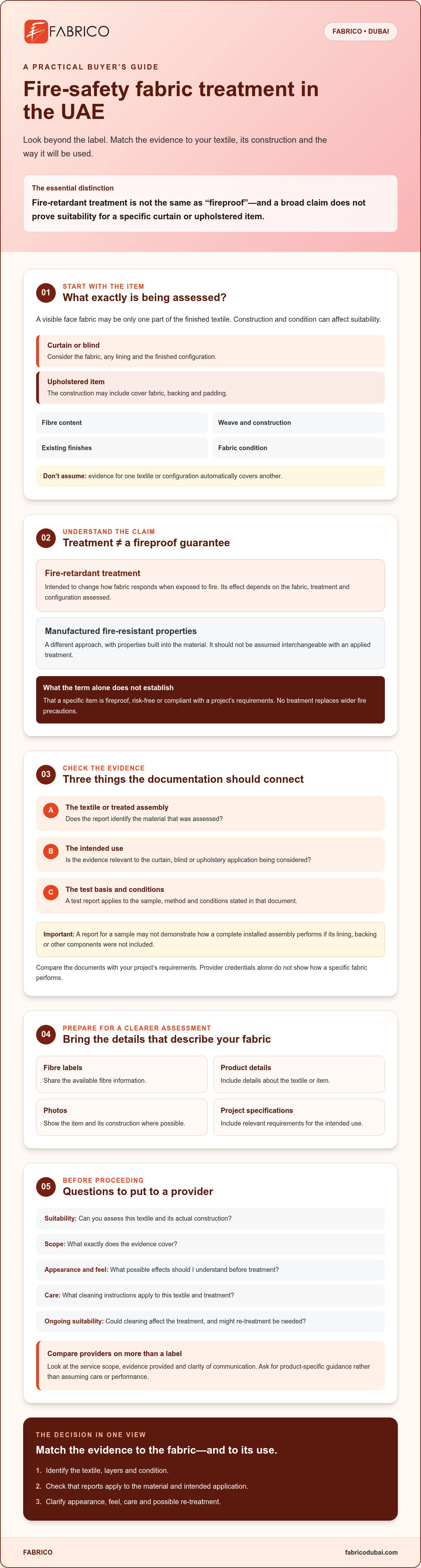
Fire-retardant treatment is intended to change how fabric responds when exposed to fire. Its effect depends on the fabric, the treatment and the configuration assessed. The term alone doesn’t tell you how a particular curtain or upholstered item will perform. It also doesn’t mean fireproof, risk-free or automatically compliant with a project’s requirements.
For UAE homes, hotels and other properties, the key question is whether the available evidence applies to the textile and its intended use. Treating existing curtains or upholstery is different from choosing fabric manufactured with fire-resistant properties. In either case, ask what material or finished construction was assessed. Don’t assume results for one textile apply to another. Fire-retardant fabrics offers a general overview of the subject, including approaches and testing standards.
How fire-retardant treatment differs from fireproof fabric
Fire-retardant describes fabric intended to resist or slow aspects of fire behaviour under specified conditions; fireproof implies an absolute protection that fabric treatment cannot promise. Performance depends on the material, treatment and tested configuration. No treatment replaces wider fire precautions or establishes compliance by itself. Check evidence for the specific textile and application instead of relying on a broad product description.
Which interior fabrics might need closer assessment?
Curtains and blinds hang freely and may include linings or other components. Upholstery is fitted over furniture and can involve several layers, including fabric, backing and padding. These differences affect what should be assessed. For example, a result for curtain fabric shouldn’t be assumed to cover a finished upholstered item.
Fibre content, weave, lining, existing finishes and the textile’s condition may all affect suitability. Share fabric labels, product details and photos with a provider, then confirm what can be treated and what evidence relates to that particular use. Fabrico offers fire-retardant treatment alongside curtain and upholstery services. Discuss suitability and documentation for the specific item.
If upholstery is part of your project, Fabrico’s guide to bespoke upholstery services in Dubai can help you explore the upholstery context. For fire safety fabric treatment UAE decisions, focus on matching evidence to the fabric and its intended application, rather than assuming a general treatment claim covers every interior textile.
How fire-retardant fabric treatment works and what affects results
Fire-retardant treatment is intended to alter how a textile reacts to fire, but the process and effect vary. At a high level, treatments may involve applying a product to fabric, while some textiles are manufactured with fire-resistant properties built into the material. These approaches aren’t interchangeable. Neither should be assumed suitable without checking the textile, intended use and supporting evidence. Fabrico offers fire-retardant treatment; ask about the method and compatibility for the item being considered.
Construction matters as much as the visible face fabric. A curtain may have a separate lining, while upholstery can combine cover fabric, backing and padding. Fibre composition, weave, existing finishes and fabric condition may influence whether treatment is appropriate and how the finished item should be cared for. Cleaning requirements can also depend on the treatment and textile, so request product-specific guidance rather than assuming performance or care instructions.
Why fabric composition and construction matter
Different fibres and constructions may respond differently to treatment. A sample of unlined curtain fabric isn’t automatically representative of a lined curtain, Roman blind or upholstered seat. Existing coatings, wear or previous cleaning may also affect the assessment. Ask the provider to review the actual textile or a representative sample and explain exactly what the assessment covers before discussing compatibility or expected performance.
What testing can and cannot tell a buyer
A test report applies to the sample, test method and conditions stated in that document. It may not establish the performance of a complete installed assembly if the tested sample didn’t include its lining, backing or other components. Check that the report identifies the textile assessed and is relevant to the intended application. For curtains and draperies, ask whether testing refers to the NFPA 701 standard, then verify with the project’s responsible specialist whether that test basis is appropriate to the UAE requirements for your property. A standard reference alone doesn’t prove that a treated item meets every project requirement.
Before proceeding, request clear answers about the assessment scope, documents supplied and care guidance. If cleaning, alteration or re-treatment could affect the textile, ask how those changes should be handled and whether the available evidence remains relevant. If you’re considering fire safety fabric treatment UAE services for curtains or upholstery, Fabrico’s fabric-treatment services are a starting point for discussing the specific item and asking what documentation may be available.
How to compare fire-safety fabric treatment evidence in the UAE
A provider’s experience or credentials can help you assess who you’re dealing with, but they aren’t proof that a particular curtain or upholstered item has been tested. For fire safety fabric treatment UAE projects, compare documents with the actual textile, its use and the project’s requirements. Ask what product or service is identified, and whether the evidence relates to a fabric sample, treated finished item or installed assembly.
Evidence should identify what was tested and under which conditions. Use this checklist to review what each provider supplies:
| Scope to compare | What to check |
|---|---|
| Textile assessed | Does the document identify the fabric or sample, including relevant construction details? |
| Intended use | Was the assessment for curtains, upholstery or another application, and does that match your item? |
| Test basis | Which test method or standard is named? Are the sample and test conditions described? |
| Documents supplied | Can the provider share the relevant report or certificate and explain its scope and limitations? |
| Care guidance | Are cleaning, washing, alteration or possible re-treatment instructions provided for the treated textile? |
Documents and answers to request from a UAE provider
Ask the provider to identify the treatment service or product used and specify what the supplied documentation covers. Review the report or certificate for the tested sample, test date, method and any stated limitations. Confirm whether it applies to treated fabric alone, the finished product with its lining or backing, or the installed application. If a detail is unclear, request an explanation in writing before relying on the document.
How to interpret approvals, standards and claims
Broad statements about company approval or credentials shouldn’t be taken as proof of every treatment, fabric or result. Keep provider qualifications separate from textile-specific test evidence. A report for one sample also doesn’t automatically establish performance for a different fabric or complete assembly.
The UAE Fire and Life Safety Code of Practice may be relevant, but applicable requirements depend on the project, building and intended use. Ask the project consultant or relevant authority to confirm the requirements and current code provisions. Standards such as NFPA 701 for curtains and draperies, or BS 5852 for upholstery and seating, may be referenced in this market. Verify with the responsible specialist whether a particular standard suits your application. A standard named in a document is not, by itself, confirmation of project compliance.
How to prepare curtains or upholstery for fire-retardant treatment
Preparing a few details helps a provider assess whether an existing textile may be suitable and what evidence could apply. Before arranging fire safety fabric treatment UAE, collect information about the item and why treatment is being considered. A provider should review those details before confirming suitability or making claims about performance.
Questions to answer before arranging treatment
Start with the item and its intended setting. A curtain, Roman blind, sofa and chair can have different constructions, so describe the actual application rather than simply saying “fabric”. Gather what you know, even if some details are incomplete:
- Identify the item: Note whether it’s a curtain, blind, sofa, chair or another textile application, and where it’s used.
- Describe its construction: Check the fibre label if available, and note any lining, backing or other layers.
- Record its condition: Include its approximate age, visible wear or damage, and any previous cleaning, treatments or alterations.
- Clarify the requirement: Explain whether treatment is a personal preference, a project brief requirement or a request linked to an authority.
- Share useful references: Provide product details, clear photos, labels and relevant project specifications.
Ask the provider to assess the specific textile or a representative sample and explain what the assessment covers. If the fabric, construction or condition is uncertain, don’t rely on a general assurance that all textiles are compatible. Before proceeding, confirm which item is included, what documents may be supplied and whether those documents address the intended application.
Care, cleaning, and future treatment
Request written care instructions for the treated fabric and the treatment process. Ask whether cleaning, washing, repairs or later alterations could affect the treatment or the relevance of its evidence. Don’t assume there’s a universal re-treatment interval. Ask the provider what signs or changes should prompt a fresh assessment.
Keep treatment purposes distinct. Water repellency addresses a different property from fire-retardant treatment, so one shouldn’t be taken as evidence of the other. Follow the care advice supplied for each treatment and confirm whether both are suitable for the same textile before proceeding.
For a considered assessment, discuss your fabric and intended application with Fabrico, a Dubai-based specialist offering fire-retardant treatment alongside curtain and upholstery services.
Choosing a fire-safety fabric treatment provider in the UAE
A suitable specialist should do more than describe a treatment in broad terms. Look for a provider who asks about the fabric and its intended environment, explains what can be assessed, and sets out what documents and care guidance may be available for that specific item. Clear communication matters: you should understand the service scope, its limitations and who can answer technical or project-specific questions.
A practical checklist for evaluating a treatment specialist
Use these points to guide your discussion before choosing a provider:
- Fabric assessment: Does the provider ask about fibre content, construction, condition and any lining or backing?
- Intended use: Do they distinguish between curtains, blinds and upholstered furniture rather than treating them as identical applications?
- Clear scope: Can they explain which item or sample will be assessed and what the service includes?
- Relevant evidence: Do they identify the test documentation available and explain what it does, and does not, demonstrate?
- Care guidance: Will you receive instructions relevant to the treated textile, including what to check before cleaning or making alterations?
- Technical communication: Can they address questions about documentation, or direct you to the appropriate project specialist when requirements need further verification?
For a commercial project, confirm applicable requirements with the project consultant or relevant authority. Don’t treat a provider’s general credentials or approval claims as proof that every fabric, treatment or installed item meets the project’s requirements.
Discuss your fabric treatment needs with Fabrico
Fabrico is a Dubai-based soft-furnishings and fabric-treatment specialist offering fire-retardant treatment alongside curtain and upholstery services. It may be an option for UAE customers considering treatment for these interior textiles. Confirm suitability, available documentation and care guidance for the specific fabric and application.
To start a fabric-specific discussion, share what the item is, where it will be used, any known fabric details and the relevant project requirements. Discuss your fabric treatment requirements with Fabrico and ask what assessment and documentation may be available for your item. This helps you evaluate fire safety fabric treatment UAE options without assuming a particular outcome or compliance status.
Make your next fabric-treatment decision with confidence
Choosing fire safety fabric treatment UAE starts with the textile itself. Curtains, blinds and upholstery can differ in fibre, construction and intended use. Ask the provider to assess the specific item, then check that any test report or certificate identifies what was tested, the conditions and the document’s limitations. Treatment isn’t a promise of fireproofing or automatic compliance, so confirm project requirements with the relevant specialist.
Preparing fabric details, photos and project specifications can make that discussion more useful. Before proceeding, request care instructions and ask whether cleaning or alterations could affect the treatment. Fabrico is a Dubai-based provider of fire-retardant treatment, with curtain and upholstery services relevant to interior textiles. Confirm suitability and available evidence for your particular fabric and application.
Discuss your fabric treatment requirements with Fabrico and share the item’s details and intended use. A careful, evidence-led conversation is a practical first step toward choosing an option that fits your needs.
Frequently Asked Questions
What is fire-retardant fabric treatment?
Fire-retardant fabric treatment is a process intended to affect how a textile responds when exposed to fire. The result depends on the fabric, its construction, the treatment and the conditions under which performance is assessed. Treatment may be applied to an existing textile, while some fabrics are manufactured with fire-resistant properties. Ask what material was assessed and whether the evidence relates to your specific curtain, blind or upholstered item.
Does fire-retardant treatment make fabric fireproof?
No. Fire-retardant treatment doesn’t make fabric fireproof or remove fire risk. It’s intended to influence fire behaviour under specified conditions, and any performance claim should be supported by evidence relevant to the material and its use. Treatment also doesn’t replace other fire precautions. Before relying on a treated textile, check the test documentation and confirm whether it meets the requirements for your building or project.
Is fire-retardant fabric treatment required in the UAE?
Whether treatment is needed depends on the building, application and project requirements. Don’t assume the same answer applies to every home or business. The UAE Fire and Life Safety Code of Practice is a key reference, but confirm the applicable requirements for a specific textile with the project consultant or relevant authority. In Dubai, ask the responsible project specialist whether the curtain or upholstery specification needs particular evidence or testing.
Can existing curtains or upholstery be treated?
Some existing curtains or upholstered items may be candidates for treatment, but suitability must be assessed for each textile. Fibre content, lining, backing, previous finishes and fabric condition can all matter. Share labels, product details and clear photos with the provider, and ask what the assessment covers. Fabrico, a Dubai-based specialist, offers fire-retardant treatment. Confirm whether your specific fabric and finished item can be treated.
How can I verify a fabric treatment claim in the UAE?
Request the relevant test report or certificate and check that it identifies the sample, test method, conditions and limitations. Confirm whether the evidence applies to treated fabric alone, a finished item with its lining or backing, or the installed assembly. For fire safety fabric treatment UAE, a provider’s credentials or broad approval statement aren’t a substitute for textile-specific evidence. Check project requirements separately with the responsible consultant or authority.
Will fire-retardant treatment change the look or feel of fabric?
It may, but the effect depends on the treatment and textile, so there isn’t a reliable universal answer. Discuss possible changes in appearance or handle before treating a finished curtain or upholstered item. Ask whether a sample assessment is possible and whether it can indicate likely effects. Confirm which fabric the assessment represents, since results may not transfer to a different weave, lining or finish.
Does treated fabric need special cleaning or re-treatment?
Care requirements depend on the treatment and fabric. Ask for written instructions that specify suitable cleaning methods and whether washing, alterations or other work could affect the treatment or its supporting evidence. Don’t assume there’s a standard re-treatment interval for every textile. Ask the provider what changes or care events should prompt a new assessment, and retain the treatment documents with the item’s care information.
What should I ask a fire-retardant fabric treatment company before hiring it?
Ask whether the provider can assess your fabric and explain the service scope, relevant test evidence and its limitations. Confirm whether documents cover the treated fabric, finished item or installed application, and request care instructions. Ask who can clarify project-specific requirements if needed. For a Dubai enquiry, share the item type, fabric details, intended use and any project specifications with Fabrico, which offers fire-retardant treatment for discussion.