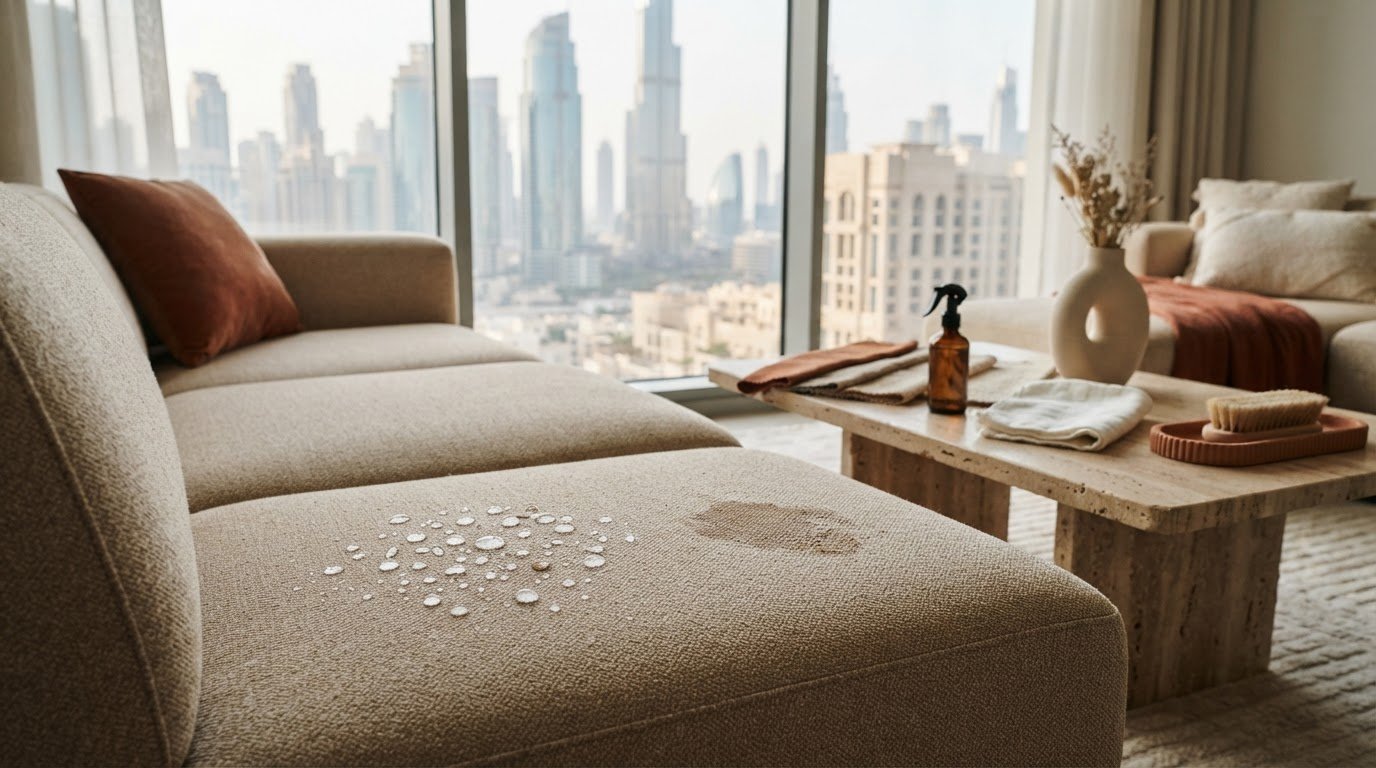

Water repellent treatment for sofa fabric can give you extra time to deal with a spill, but it won’t make your upholstery waterproof. It’s also sensible to consider whether a treatment is suitable for your sofa’s fabric and finish before choosing one. The aim is to add resistance to liquid, not to promise that every spill will leave no mark.
In a Dubai home, sofas may face everyday spills, dust and frequent use. The right approach depends on the upholstery and how the sofa is used. A DIY spray may suit a straightforward application when its label covers the fabric, while delicate or textured upholstery calls for particular care. A treatment that works for one material may not be right for another.
This guide explains what water repellency can and can’t do, what to consider before treating your sofa, and how to respond to spills on treated fabric. It also compares DIY products with professional treatment. Fabrico provides water-repellent fabric treatments alongside sofa and chair upholstery services in Dubai.
Key Takeaways
- Water repellent treatment for sofa fabric can help liquid bead temporarily, but it doesn’t make upholstery waterproof or stain-proof.
- Fabric type, condition, existing finishes and intended use all affect whether treatment is suitable.
- With a DIY spray, you select the product and apply it. Professional treatment offers an upholstery service informed by the fabric.
- For spills, blot gently, avoid rubbing and follow the sofa’s fabric-care instructions.
- Fabrico provides sofa and chair upholstery alongside stain- and water-repellent treatments in Dubai.
What Water-Repellent Treatment for Sofa Fabric Actually Does
Water-repellent treatment for sofa fabric helps liquid bead on the surface or remain there temporarily instead of soaking in straight away. How well it works depends on the upholstery material and the treatment. The practical benefit is often extra time to respond to a spill, not a guarantee that the sofa will remain untouched.
“Water-repellent” and “waterproof” set different expectations. A treated sofa can still absorb liquid, develop a mark or be affected by a spill. Treatment is one part of upholstery care, alongside prompt cleanup and following the fabric’s care instructions.
Water-repellent versus waterproof: the practical difference
Water repellency means a fabric may resist liquid for a time, giving you an opportunity to blot a spill before it penetrates more deeply. Waterproofing implies a stronger barrier against water passing through. Don’t assume a fabric treatment makes a sofa waterproof. In plain terms: water repellency can buy time for cleanup, but it doesn’t make sofa fabric waterproof.
What sofa owners can reasonably expect
Expect possible resistance to liquid absorption, not guaranteed prevention of stains or damage. Results vary with the fabric, its condition, the application and the liquid involved. A small spill may sit on the surface long enough to blot, while a larger spill or one left unattended may reach the upholstery. Even when liquid beads, colour or residue in the spill can still leave a mark.
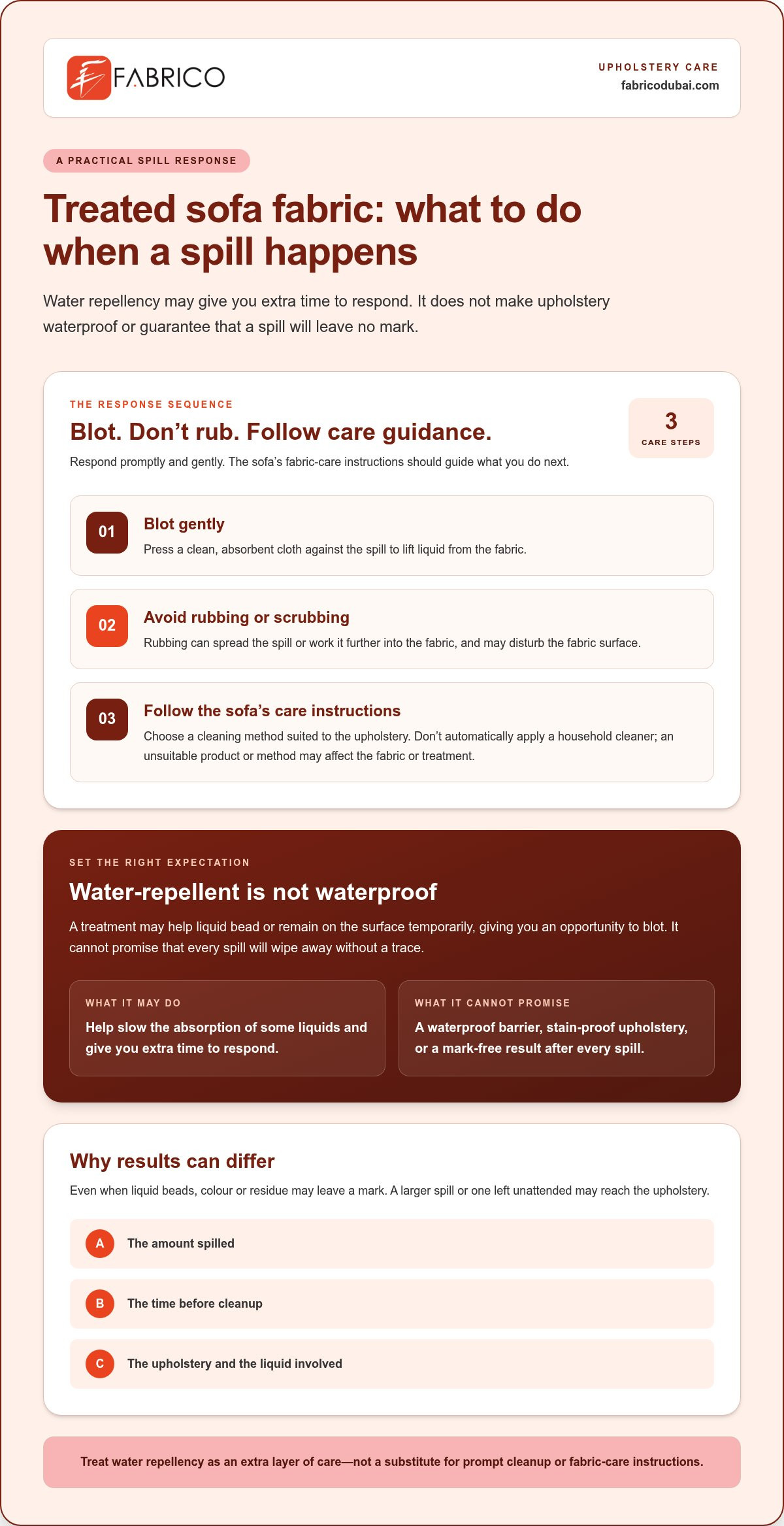
Act promptly, but gently. Rubbing can spread liquid or work it further into the fabric, so use a clean, absorbent cloth to blot instead. Don’t automatically apply a household cleaner: an unsuitable product or method may affect the upholstery or treatment. Follow the sofa’s fabric-care instructions to decide what to do next.
- Blot: Press a clean, absorbent cloth gently against the spill to lift liquid.
- Don’t rub: Avoid scrubbing, which can spread the spill and disturb the fabric surface.
- Follow care guidance: Use a cleaning method suited to the sofa fabric.
Think of treatment as an additional layer of care, not a substitute for a quick response. It may help slow the absorption of some liquids, but it can’t promise that every spill will wipe away without a trace. The amount spilled, the time before cleanup and the upholstery itself all affect the outcome. Knowing these limits helps you make practical use of the protection without relying on it as a guarantee.
How Water-Repellent Sofa Fabric Treatment Works
A fabric treatment is applied to upholstery to help it resist liquid, but the right approach depends on the sofa. Fabric construction, condition, existing finishes and everyday use all affect whether treatment is suitable and how it should be considered.
Fabric type, condition, existing finishes and intended use are the main factors that affect treatment suitability. Considering them first helps set realistic expectations and identify details that could affect the appearance or performance of the finished upholstery.
Why the sofa fabric and its condition matter
Fibre and weave influence how a fabric responds to treatment. Colour and age can also matter when considering its appearance, while existing finishes may affect how a new treatment interacts with the surface. Visible soil, wear or previous damage can influence preparation and the final look. An even result shouldn’t be assumed without considering the sofa’s current condition.
Upholstered fabric is not the same as leather or other furniture surfaces. A treatment intended for fabric shouldn’t be assumed suitable for every material. Two sofas with different weaves or finishes may need different considerations, even if they’re used in the same room.
What happens during a professional treatment
A professional fabric treatment involves considering the upholstery and the treatment requested. The fabric’s current state matters when planning the work, and the exact steps depend on the upholstery and treatment. Don’t assume that the same tool, formula or drying period applies to every sofa.
Fabrico provides specialized water-repellent treatment as part of its upholstery services in Dubai. The company also offers sofa and chair upholstery, making treatment a practical option to consider as part of upholstery care. The fabric itself should guide expectations, rather than a generic description that treats every sofa as though it were made from the same material.
Research into fabric coatings also shows why the word “treatment” can cover different approaches. MIT research on water-repellent coatings discusses coating science and concerns around chemicals used in some approaches. It provides context, but it isn’t evidence that every upholstery treatment uses the same chemistry or works in the same way.
Before choosing water repellent treatment for sofa fabric, consider what the sofa is made of, its present condition and how it’s used day to day. A fabric-focused decision is more useful than applying a generic solution. Dubai homeowners can explore Fabrico’s sofa fabric services for upholstery and fabric treatments.
DIY Fabric Spray or Professional Sofa Treatment: How to Compare
Retail fabric sprays and professional services both aim to add water-repellent protection, but the process and responsibility differ. With a DIY product, you choose the spray and handle the application. With professional treatment, the service is considered in relation to the upholstery and the treatment requested. Neither option should be assumed to suit every sofa or guarantee a particular result.
Compare the practical differences before deciding:
| Consideration | DIY fabric spray | Professional sofa treatment |
|---|---|---|
| Application responsibility | You select the product and apply it according to its label. | The service is carried out professionally, with the upholstery and requested treatment considered. |
| Fabric-specific guidance | You assess whether the product label covers your sofa’s material and finish. | Fabric suitability can inform the treatment approach. |
| Convenience | A retail product can be readily available, but preparation and application are your responsibility. | The treatment is arranged as an upholstery service rather than a self-applied product. |
| Limits | Results depend on product directions, compatibility and how it is applied. | Professional application doesn’t make fabric waterproof or remove the need to follow care guidance. |
When a DIY spray may suit the situation
A DIY spray may be practical for a small fabric item when its label clearly indicates compatibility. Read the directions carefully and test an inconspicuous area if instructed. You’re responsible for selecting a suitable product, preparing the item as directed and applying it consistently. Uneven application or an incompatible product can affect the result, so don’t improvise beyond the label.
When professional sofa treatment may be a better fit
A large, valuable or frequently used sofa can be more challenging to treat evenly at home, especially when its fabric or finish needs careful handling. Professional treatment is an upholstery-focused alternative, but it shouldn’t be assumed to deliver longer-lasting or superior performance in every case. Fabrico provides specialized water-repellent treatment for upholstery in Dubai, alongside sofa and chair upholstery services.
The distinction between terms such as breathable and waterproof also depends on how a textile is designed. The American Chemical Society’s coverage of breathable waterproof textiles discusses performance in outdoor apparel. Those findings shouldn’t be taken as a specification for sofa treatments. Product directions and the needs of the actual upholstery remain central to choosing a suitable approach.
When comparing options for water repellent treatment for sofa fabric, consider the sofa’s material, condition, size and use. Then weigh the hands-on responsibility of DIY against a professional upholstery service. Fabrico’s Dubai upholstery services bring sofa upholstery and specialized fabric treatments together, making treatment part of a broader upholstery-care decision.
Caring for Water-Treated Sofa Fabric in a Dubai Home
A treated sofa still needs thoughtful care. If a drink spills during a family gathering or a cup tips over during everyday use, respond promptly and gently. The fabric and treatment affect which cleaning method may be suitable, so don’t assume that a surface that initially resists liquid can be left without attention.
What to do after a spill
Use this simple sequence to manage a fresh spill while protecting the upholstery:
- Lift away excess liquid. Use a clean, absorbent cloth and gentle pressure. Work carefully rather than pushing the spill deeper into the fabric.
- Avoid rubbing or scrubbing. Friction can spread the liquid and disturb the fabric surface. Don’t apply heat, which may affect the upholstery.
- Check the care instructions. Follow the sofa maker’s guidance before using a cleaning product or method. If the instructions don’t recommend a cleaner, don’t assume it’s suitable for treated fabric.
- Clean as directed if needed. A treated surface may still need appropriate cleaning after contact with liquid. Choose a method that suits both the upholstery and the treatment.
Resist the urge to reach for a strong household cleaner simply because a mark remains. Products intended for other surfaces may not be appropriate for upholstery. Gentle blotting is a first response, not a substitute for fabric-specific care if the spill leaves residue or a visible mark.
How Dubai households can plan ongoing fabric care
Build routine care around the sofa’s fabric instructions and how the household uses it. A sofa in a frequently used family living room may need attention more often than one used occasionally, but the right routine depends on the upholstery. Don’t adopt a fixed cleaning schedule or treatment reapplication interval without guidance specific to the fabric and treatment.
Keep the care instructions accessible and note the treatment details so you can refer to them before cleaning. If you’re deciding whether to use a particular upholstery cleaner, first check that it suits the sofa’s material and doesn’t conflict with the treatment guidance. That’s more reliable than assuming every treated sofa responds in the same way.
For Dubai homeowners, everyday habits are more useful to consider than broad assumptions about local conditions. Think about where the sofa is used, who uses it and how likely spills or marks are. These details can help you choose a practical care routine for your home.
Water repellent treatment for sofa fabric works best as one part of a considered care routine, not as a reason to delay cleaning or use an unapproved product. For professional upholstery treatment in Dubai, explore Fabrico’s water-repellent treatment service.
Choosing Fabrico for Sofa Fabric Water-Repellent Treatment in Dubai
Choosing protection for a sofa means considering the upholstery as well as the treatment. The fabric, its current condition and how the sofa is used all help shape a practical approach. Fabrico provides sofa and chair upholstery alongside specialized stain- and water-repellent treatments, bringing fabric protection into a broader upholstery service.
Based in Dubai, Fabrico has more than 35 years of experience in soft furnishings and upholstery. Its local experience is relevant if you’re looking for water-repellent treatment as part of sofa care, rather than a standalone promise that every spill will disappear.
A tailored approach to sofa fabric protection
No single treatment should be assumed to suit every sofa. Fabric type, visible condition and existing finish can affect whether treatment is appropriate. The sofa’s intended use helps clarify what kind of practical protection you’re looking for. A family sofa used throughout the day, for example, has different demands from a formal seating area used occasionally. These details are a more useful starting point than choosing a treatment based on a broad claim.
Fabrico offers specialized stain- and water-repellent fabric treatments alongside sofa and chair upholstery. This makes treatment a relevant option within its upholstery services. The purpose is to add a considered layer of protection, not to change the basic expectations of fabric care.
Keep expectations measured. Water repellency doesn’t guarantee that every spill, stain or mark will be prevented, and treated upholstery still needs suitable care. If liquid lands on the sofa, prompt, fabric-appropriate cleanup remains part of protecting its appearance. Treatment should complement the care instructions for the upholstery, not replace them.
Explore water-repellent treatment for your sofa
Before deciding, consider three things: what the sofa fabric is, whether its present condition is suitable for treatment, and how the sofa is used in your home. Then weigh the value of added resistance to liquid against the ongoing need for careful cleanup and routine fabric care. This gives you a clearer basis for deciding whether professional treatment suits your needs.
For Dubai homeowners, Fabrico offers sofa and chair upholstery alongside specialized water-repellent treatment. The service is intended as practical fabric protection, not a promise of immunity from every spill or mark. Explore Fabrico’s fabric treatment services to take a practical next step in caring for your sofa.
Make a Thoughtful Choice for Your Sofa
Protecting upholstery begins with choosing an approach that suits the sofa, not simply the strongest-sounding promise. Consider how the fabric is used at home and what kind of care you’re prepared to give it. Water repellent treatment for sofa fabric can be a practical part of that plan, alongside realistic expectations and attentive upkeep.
Fabrico provides sofa and chair upholstery alongside specialized stain- and water-repellent treatments. As a Dubai-based specialist with more than 35 years of experience, Fabrico offers fabric protection as part of a considered approach to upholstery, not as a guarantee against every spill or mark.
Choose protection with your fabric and everyday use in mind. Explore Fabrico’s fabric treatment services and take a practical next step towards caring for your sofa.
Frequently Asked Questions
Does water-repellent treatment make sofa fabric waterproof?
No. Treatment may affect how quickly liquid absorbs, but it doesn’t turn upholstery into a waterproof barrier. A drink might sit briefly on a treated seat, yet still leave a mark or reach the fabric if there’s enough liquid or cleanup is delayed. Treat water repellency as extra time to respond, not permission to ignore spills. Blot promptly and use care methods suited to the sofa.
Can water-repellent treatment change the look or feel of a sofa?
The effect can depend on the upholstery, its existing finish and the treatment used, so don’t assume every sofa will look or feel exactly the same afterwards. This matters especially for a sofa with a delicate texture or carefully chosen colour. A fabric-specific assessment can take appearance into account. Any definite claim about changes to colour, texture or breathability should be based on information about the treatment being applied.
How often should sofa fabric receive water-repellent treatment?
There isn’t one reapplication interval that suits every sofa. Daily use, cleaning methods, the fabric itself and the specific treatment can all influence how protection performs over time. Follow the care guidance for the sofa and treatment rather than choosing a calendar-based schedule. A change in how a spill behaves may be a reason to review the care instructions, but it doesn’t by itself establish that retreatment is needed.
What happens if liquid spills on a treated sofa?
Respond promptly. Use a clean, absorbent cloth to lift liquid with gentle pressure, and avoid rubbing, which can spread it across a larger area. If the spill is coloured, such as tea or juice, don’t assume a quick surface wipe has removed all residue. Check the sofa’s care instructions before using a cleaner, since a product suitable for one upholstery fabric may not suit another.
Can an older sofa receive water-repellent fabric treatment?
Possibly, but age alone doesn’t determine whether treatment is suitable. The upholstery’s material and present condition matter more. An older sofa with visible wear, previous cleaning or existing marks may need different consideration from one that’s well maintained. Treatment shouldn’t be expected to reverse fading, repair worn fabric or remove established stains. A fabric-focused assessment helps set appropriate expectations before deciding.
Is water-repellent treatment suitable for every sofa fabric?
No. Upholstery varies in fibre, weave, colour, finish and care requirements, so don’t assume a general-purpose spray is compatible with every sofa. Check the product directions for the specific fabric and follow the sofa’s care label. This is especially important for delicate or specialized upholstery, where a mismatched product could affect the result. In Dubai, fabric-specific guidance helps you choose protection suited to your sofa rather than relying on a broad claim.