

The best protection for new upholstery may be the treatment you decide not to apply. Stain guarding for new furniture Dubai should start with fabric suitability, not a blanket promise that every sofa or chair can be treated. A spill on brand-new upholstery can feel like a permanent risk, while an unsuitable product may affect the look or feel you chose so carefully.
Pause before booking. A stain- or water-repellent treatment may help manage some spills, but it does not make fabric stain-proof or immune to damage. The right choice depends on the upholstery and how the furniture will be used. This guide explains what to check about compatibility, appearance, care and protection limits, and how to assess a Dubai provider before proceeding.
Before arranging treatment, confirm how the provider assesses your fabric and what preparation or aftercare is required. Fabrico offers stain- and water-repellent fabric treatments and has approximately 35 years of experience in the Dubai market. Use this guide to make a considered choice for your new furniture while keeping its finish and comfort in mind.
Key Takeaways
- Use the fabric details and care label to assess whether stain guarding may be suitable for your new sofa or chair.
- Compare professional treatment, a consumer-applied protector and no added treatment by who checks compatibility, who applies the product and how clearly aftercare is explained.
- Ask the furniture retailer whether treatment could affect the warranty or recommended care instructions before arranging application.
- With stain guarding for new furniture Dubai, clarify the treatment’s stated limits and what to do if a spill occurs.
- Fabrico offers stain- and water-repellent fabric treatments in Dubai and has approximately 35 years of experience in the local market.
Stain Guarding for New Furniture in Dubai: Capabilities
New sofas and chairs often become part of everyday life as soon as they arrive, so buyers may consider fabric protection before regular use begins. Stain guarding is a treatment intended to reduce how readily some spills adhere to or penetrate upholstery. It may make certain spills easier to manage, but it does not make fabric invulnerable. For background on the history of a well-known fabric-protection brand, see Scotchgard.
Stain resistance may help limit how quickly a spill affects fabric; it is not a guarantee against staining. A general claim of “protection” is not enough to decide whether a treatment suits a particular new piece. Suitability and expected performance depend on the upholstery and the treatment specified for it, so ask for fabric-specific guidance before booking.
How fabric protection relates to new upholstery
Start with the manufacturer’s care label, product documentation or retailer’s records. Confirm the fabric composition and any treatment restrictions before asking about protection. If those details are unavailable, ask the retailer to identify the upholstery rather than relying on its appearance alone. A professional provider can then discuss whether its treatment is suitable for that material and what it is intended to help with.
Discussing treatment before the furniture enters regular use gives you time to clarify the process and care expectations. It does not mean every new sofa or chair needs treatment. Assess suitability individually and keep the retailer’s instructions in mind. Professional fabric treatment is also different from routine cleaning: treatment is intended to reduce the fabric’s susceptibility to some spills, while cleaning addresses soil or marks already present. Neither should be assumed to replace the other.
What stain resistance does not guarantee
Results can vary with the type of spill, upholstery fabric, treatment and how quickly the spill is addressed. A repellent treatment does not promise that every liquid or substance will stay on the surface, or that no mark, colour change or other damage can occur. Think of it as limited protection, not permission to leave a spill unattended.
After treatment, continue to follow the furniture manufacturer’s care instructions and ask the provider to explain any additional guidance before you proceed. Confirm what to do if a spill occurs, which cleaning steps to avoid and whether the treatment changes the recommended care routine. For stain guarding for new furniture Dubai, these fabric-specific answers are more useful than a broad assurance that upholstery is protected.
How stain-guarding treatments work on furniture fabrics in Dubai
Fabric protection is a surface-treatment process intended to help reduce how readily certain spills adhere to or penetrate upholstery. Methods and suitability depend on the treatment and the fabric, so do not assume every service works the same way. Some approaches draw on nanotechnology in fabric protection, but that does not mean every furniture treatment uses nanotechnology or produces the same result.
Identify the upholstery first, because treatment selection should follow the fabric rather than the other way around. This matters with new furniture, where a finish, colour or construction may have specific care requirements. Check the care label and manufacturer’s guidance, then ask the provider to confirm compatibility before you book.
Why the fabric assessment matters before application
Give the provider the clearest information available, such as the fabric composition and care instructions. If you are unsure of the material, ask the retailer or manufacturer to identify it. Particular finishes, colours or fabric construction may call for specific handling. Rather than relying on a general assumption, ask the treatment provider what they can confirm for your piece. Resolve any uncertainty about compatibility before proceeding.
What to ask about application and aftercare
Ask the provider to explain the steps involved without assuming there is one universal process. Find out how the furniture will be prepared, how the treatment will be applied to that fabric and what you will need to do afterwards. Confirm directly whether there are waiting periods, ventilation needs or restrictions on using the furniture. Request written aftercare instructions, including how to respond to spills and which cleaning methods to avoid.
When speaking with a Dubai provider, describe how the furniture will be used and where it will sit. A frequently used family sofa and an occasional-use chair have different patterns of contact. Ask whether your room conditions or furniture routine affect the care recommendations. This helps set practical expectations without assuming that a particular local condition changes every treatment’s performance.
A useful process summary is: assess the fabric, confirm suitability, apply the treatment as specified, then follow the aftercare guidance. Each step matters. For stain guarding for new furniture Dubai, look for a provider discussion that explains both the proposed treatment and its limits. If you are considering Fabrico’s stain- and water-repellent fabric treatments, share the furniture’s fabric details and ask what suitability and care guidance can be confirmed before arranging treatment.
Compare stain-guarding options for sofas and chairs in Dubai
The right option depends on the upholstery, the care guidance and how much responsibility you want to take for assessing and applying protection. A professional service can discuss fabric suitability, while a consumer-applied protector leaves product selection and application to you. Choosing no added treatment is also reasonable if that best fits the furniture’s care requirements or your preferences.
| Consideration | Professional treatment | Consumer-applied protector | No added treatment |
|---|---|---|---|
| Assessment | Ask what fabric details the provider needs and how compatibility is assessed. | Check the product instructions against the furniture’s care guidance. | Use the manufacturer’s care information to guide routine use. |
| Application responsibility | The service provider applies the treatment as agreed. | You select and apply the product according to its instructions. | No protector is applied. |
| Fabric-specific advice | Confirm whether the treatment is suitable for your particular upholstery. | Check that the product instructions cover your fabric before use. | Follow the retailer or manufacturer’s fabric-care advice. |
| Aftercare clarity | Ask for written care and spill-response guidance. | Follow both the product directions and furniture-care guidance. | Follow the furniture-care instructions. |
| Limitations | Ask what the treatment may help with and what it will not protect against. | Review the product’s stated limitations; do not assume it suits every fabric. | There is no added treatment, so rely on the care instructions and prompt spill response. |
Professional treatment or a do-it-yourself fabric protector?
For professional treatment, ask who will assess compatibility, what the service includes and who will explain aftercare. With a consumer-applied product, you take on those checks and the application yourself. Follow the product directions and furniture-care guidance, and do not apply a protector if compatibility is unclear. Avoid choosing based on broad claims about durability or performance that are not supported by details for your fabric and treatment.
A buyer checklist for comparing Dubai providers
Before booking, ask the provider:
- What fabric information do you need to assess suitability?
- What does the service include, and how will the furniture be prepared?
- What aftercare should I follow, and what are the treatment’s stated limitations?
Clear answers make it easier to compare services beyond general promises. If you are weighing stain guarding for new furniture Dubai, discuss treatment suitability with Fabrico and review its guide to water-repellent upholstery treatment in Dubai for related context.
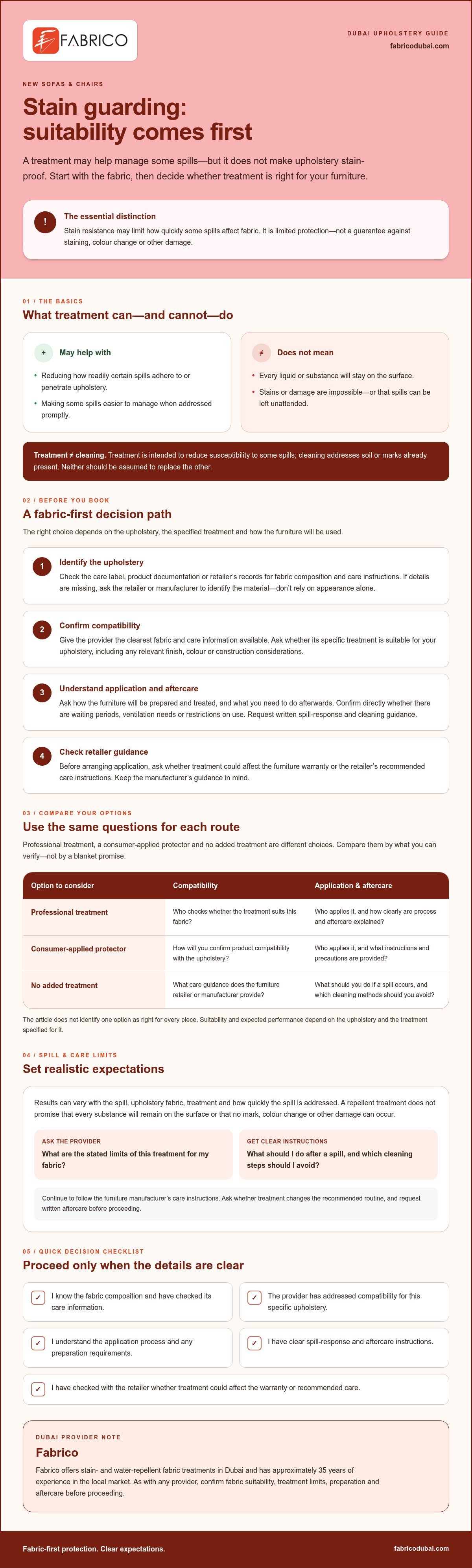
Before treating new furniture in Dubai: a practical decision checklist
A short conversation before booking can prevent confusion about suitability, preparation and care. Gather the furniture details first, then confirm the treatment plan with the provider and check any warranty or care implications with the retailer. This is especially useful if a sofa or chair has contrasting panels, trims or finishes that may not share the same care requirements.
Questions to resolve before booking a treatment
- Collect the fabric details. Keep the care label, product documentation and retailer or manufacturer guidance available. Ask the provider what information they need to assess compatibility.
- Check the furniture’s condition and preparation. Confirm that the furniture is clean and ready for the provider’s specified preparation process. Do not assume what preparation is needed; ask what applies to your piece.
- Ask about suitability checks. Find out whether a small-area test or another compatibility check is available. Confirm this directly with Fabrico rather than assuming it is part of the service.
- Flag mixed materials or finishes. Explain if the upholstery combines different fabrics, colours, trims or surface finishes. Ask how the provider will assess each component and whether all parts can be treated.
- Check with the furniture retailer. Ask whether treatment could affect the warranty or change the care instructions. Keep the retailer’s response with your furniture documentation.
- Describe everyday use. Tell the provider who uses the furniture, how often it is used, what kinds of spills are likely and where the piece will be placed. This frames a practical discussion about care without implying that treatment prevents every mark.
How to prepare for treatment and follow-up care
Before the appointment, arrange access to the sofa or chair and follow only the preparation instructions confirmed by the provider. Ask whether anything needs to be moved or cleared around the furniture, and confirm any waiting, ventilation or use guidance directly with the service provider. Once treatment is complete, request written instructions for furniture use, cleaning and spill response. Keep them alongside the manufacturer’s care information.
Consultation checklist: fabric details, compatibility, preparation, mixed materials, retailer warranty, household use, treatment limits and written aftercare. This gives you a clear basis for discussing stain guarding for new furniture Dubai and comparing the answers you receive. For related upholstery expertise, see Fabrico’s bespoke upholstery services in Dubai. To discuss whether a stain- or water-repellent treatment may suit your furniture, contact Fabrico about treatment suitability.
Choose Fabrico for stain guarding for new furniture in Dubai
Fabrico is a Dubai-based soft-furnishings and upholstery specialist offering stain- and water-repellent fabric treatments. The business has approximately 35 years of experience in the Dubai market. That local experience provides useful context, but the suitability of any treatment still needs to be considered for the individual upholstery.
For stain guarding for new furniture Dubai, treat the first conversation as a chance to establish what is appropriate, not as a promise of a particular result. Sharing accurate fabric information helps the provider discuss compatibility, process and care expectations before you decide whether to proceed.
What to discuss with Fabrico about your new furniture
Have the relevant details ready so the discussion can focus on your piece rather than general assumptions. Share:
- Furniture type: for example, a sofa, armchair or dining chair, and whether different sections use different materials.
- Fabric documentation: the composition, care label and any instructions from the manufacturer or retailer.
- Purchase details: when the furniture was bought and whether the retailer has given guidance about treatment, cleaning or warranty conditions.
- Intended use: how often the furniture will be used, who will use it and what kinds of spills are a likely concern.
Then ask whether the specific upholstery is suitable for treatment, what preparation the service requires and whether any parts should be handled differently. Request a clear explanation of the protection you can reasonably expect, its limitations and the aftercare instructions. Clarify any uncertainties before agreeing to application. The treatment should be considered in light of the fabric and its care requirements, not selected on the assumption that all upholstery responds alike.
Arrange a Dubai fabric-treatment consultation
A practical next step is a suitability conversation based on your furniture details. You can contact Fabrico about fabric treatment and ask what information is needed to discuss your new sofa or chairs. Bring the retailer’s care guidance into the conversation, especially if you are unsure whether treatment may affect its recommendations.
Take time to understand the proposed process and aftercare before making a decision. A careful discussion can help you determine whether treatment suits your upholstery and household needs, while keeping expectations realistic: stain- and water-repellent treatment does not guarantee that fabric will remain free from stains or damage.
Make a considered choice for your new upholstery
Stain guarding for new furniture Dubai is best approached as a fabric-suitability decision, not a promise that upholstery will stay mark-free. Check the care label and retailer guidance, then ask a provider to confirm whether the specific fabric is suitable, what the treatment involves and how to care for it afterwards. Professional application, a consumer-applied protector or no added treatment may each suit different furniture and preferences.
Before proceeding, clarify the treatment’s limits and ask the furniture retailer whether it could affect the warranty or care instructions. Fabrico is a Dubai-based specialist offering stain- and water-repellent fabric treatments and sofa and chair upholstery, with approximately 35 years of experience in the Dubai market.
Share your furniture and fabric details to start a practical suitability discussion. Discuss stain guarding for your new furniture with Fabrico and take the next step with clear expectations for protection and care.
Frequently Asked Questions
Is stain guarding worth applying to new furniture?
It may be worthwhile if the upholstery is suitable and you want help managing some spills during everyday use. Stain guarding for new furniture Dubai should be a considered choice, not an automatic step. Check the furniture’s care label and ask the retailer whether treatment affects its warranty or care instructions. Then ask a provider to assess compatibility and explain the treatment’s limits before deciding.
Can stain guard make upholstery completely stain-proof?
No. Stain-guarding treatment does not make upholstery stain-proof or immune to damage. How much it helps can vary with the spill, fabric, treatment and how promptly you respond. A repellent treatment may reduce how readily some spills adhere to or penetrate fabric, but marks or colour changes can still occur. Blot or clean spills only as directed by the furniture manufacturer and treatment provider.
How does professional stain guarding work on new furniture?
A professional service should begin by assessing the upholstery and confirming whether the treatment is suitable. The provider should explain the service scope, preparation requirements and application process for your furniture, then give you relevant aftercare guidance. Details can vary, so ask what applies to your specific fabric rather than assuming a standard method. Confirm any waiting, ventilation or furniture-use instructions directly with the provider.
Which fabrics can be treated with stain guard in Dubai?
Suitability depends on the upholstery fabric and the treatment specified for it, so do not assume every material can be treated. Check the care label or manufacturer documentation for the fabric composition and any restrictions. Share those details with a Dubai provider and ask them to confirm compatibility before booking. If the furniture combines different materials or finishes, mention this so the provider can advise how each part should be assessed.
Can stain-guarding treatment change the look or feel of furniture fabric?
Do not assume a treatment will leave every fabric’s appearance and feel unchanged. The result may depend on the upholstery and the treatment used, and suitability should be confirmed for your specific furniture. Before proceeding, tell the provider that preserving the fabric’s appearance and texture matters to you. Ask what they can confirm about potential changes and whether a small-area test or another suitability check is available.
How should I care for upholstery after stain-guarding treatment?
Continue to follow the furniture manufacturer’s care instructions, along with any aftercare guidance from the treatment provider. Ask for clear directions on routine cleaning, spill response and methods to avoid. Address spills promptly, but do not use a cleaning product or technique unless the care instructions allow it. Treatment may help manage some spills, but it does not remove the need for careful upkeep or guarantee that marks will not occur.
When should new furniture be treated with a stain-repellent treatment?
Discuss treatment before the furniture enters regular use, but arrange it only after confirming suitability and timing with the provider. Start by checking the care label, manufacturer guidance and any retailer warranty conditions. Then ask whether the treatment can be applied to your furniture in its current condition and what preparation is required. If the furniture has already been delivered, confirm directly with the provider whether it can be treated after delivery.