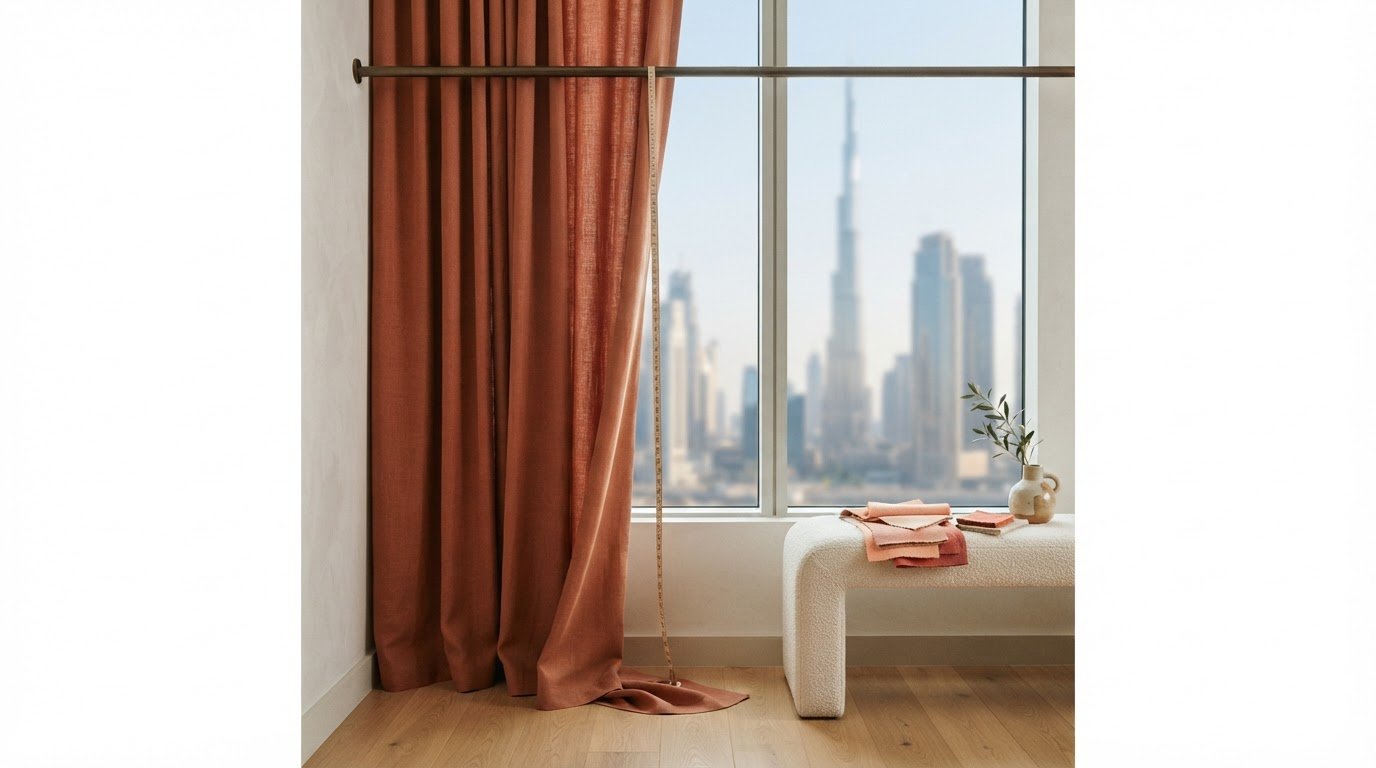

The window isn’t the whole measurement. Learning how to measure for custom curtains starts with the rod: for a tailored look, plan for total curtain width of 1.5 to 2 times the rod length when the header doesn’t have built-in fullness. For the drop, measure from the rod to the floor or sill, then choose a finish that suits the room.
It’s easy to focus on the glass and overlook where curtains will hang, how pleats affect the fabric needed, or whether the hem should skim the floor. These details shape the finished look and how curtains sit when open or closed.
This guide explains how to measure width and drop, choose a floor, puddle or sill length, and decide whether curtains should touch the floor. It also covers pleat fullness, so you can record useful measurements before choosing custom curtains for your Dubai home.
Key Takeaways
- Measure the rod or intended mounting width, not just the window glass, then allow enough panel width for the fullness you want.
- Choose the curtain drop by deciding whether you want a clean floor-skimming finish, a soft puddle, or a sill-length style.
- Factor in the header before calculating fabric: pleats and other styles create different levels of fullness and stack-back.
- For a custom pleated option in your UAE home, Fabrico offers Pleated American curtains.
How do you measure for curtains and drapes?
Learning how to measure for custom curtains starts with recording the window, fitting and intended drop separately. Then calculate the curtain width, fullness and space needed when the curtains are open.
-
Choose Panel Widths and Overlaps
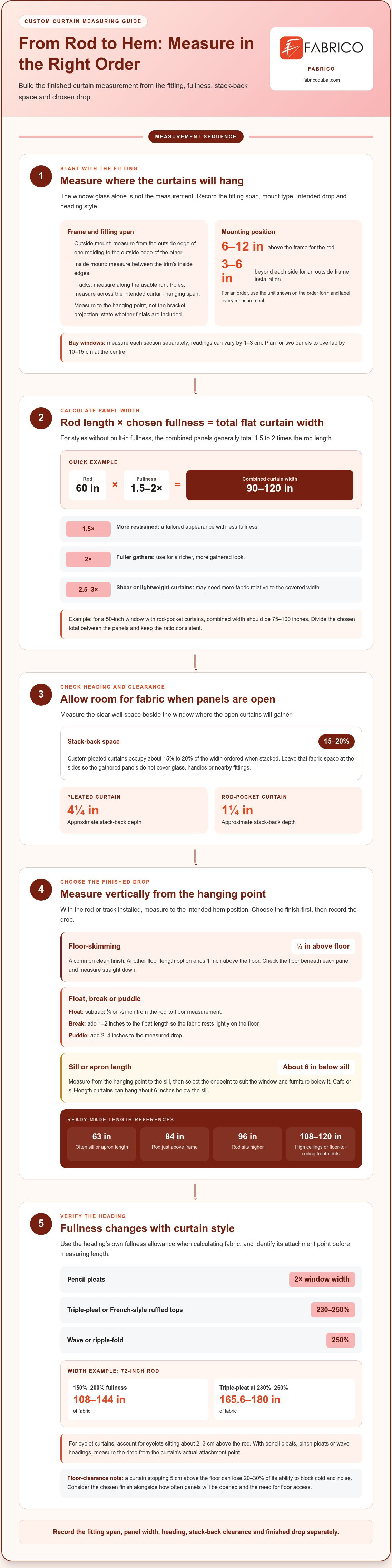
Choose total panel width based on the rod length and desired fullness. For a tailored look, panels generally total 1.5 to 2 times the rod length; a 60-inch rod needs 90 to 120 inches of combined curtain width. Divide that total between panels, allowing them to meet or overlap when closed. If you’re learning how to measure for custom curtains across a bay window, measure each section separately because readings can vary by 1 to 3 cm. Plan for two panels to overlap by 10 to 15 cm at the centre.
-
Measure the Window and Fitting
Measure the window frame from the outside edge of one molding to the outside edge of the other for custom curtains. For an inside mount, measure between the trim’s inside edges. Mount the rod 6 to 12 inches above the frame; for an outside-frame installation, extend it 3 to 6 inches beyond each side. Tracks are measured along their usable run, while poles are measured across the intended curtain-hanging span. For a UAE order, use the unit shown on the order form and label every measurement. Record the fitting span, mount type and desired drop. Measure to the curtain’s hanging point, not the bracket projection; state whether finials are included in the span and name the heading style, such as pleats.
-
Measure Curtain Width and Fullness
Multiply the rod length by the fullness you want, then compare the result with the combined flat width of the panels. A 1.5-times ratio creates a more restrained appearance, while 2 times gives fuller gathers. Sheer or lightweight curtains may need 2.5 to 3 times the covered width. If the window is 50 inches wide and you’re choosing rod-pocket curtains, the combined width should be 75 to 100 inches. Keep the chosen ratio consistent across both panels so they hang evenly.
-
Allow for Stack-Back Space
Measure the clear wall space beside the window where open panels will gather. Custom pleated curtains occupy about 15% to 20% of the width ordered when stacked, so allow for that fabric at the sides. Stack-back depth also varies by heading: pleated curtains need about 4 1/4 inches, while rod-pocket curtains need about 1 1/4 inches. Check that the gathered fabric won’t cover glass, handles or nearby fittings when the curtains are fully open.
Floor-length, pooled and sill-length curtains
Choose the finish first, then measure the drop from the installed rod or track to the intended hem position. The hanging point matters: measuring from above the window or from the floor can give you the wrong curtain length.
- Measure for a floor-skimming finish. With the rod installed, measure vertically from the curtain’s hanging point to the floor. Custom curtains commonly finish about 0.5 inches above the floor for a clean look; another floor-length option ends 1 inch above. Check the floor beneath each panel, and use a straight vertical measurement so the hem clears the floor evenly.
- Select a float, break or puddle drop. For float length, subtract ¼ or ½ inch from the rod-to-floor measurement. For a break, add 1 to 2 inches to the float length, allowing fabric to rest lightly on the floor. For a pooled effect, add 2 to 4 inches to the measured drop. Consider how the curtains look closed, and whether extra fabric suits the room’s daily use.
- Choose sill or apron length for shorter windows. Measure from the hanging point to the sill, then choose the endpoint according to the window and furniture below it. Cafe or sill-length curtains can hang about 6 inches below the windowsill for a classic finish. Ready-made lengths include 63 inches, often suited to sill- or apron-length treatments in kitchens, bathrooms and smaller windows.
- Match the finished length to rod placement and room height. An 84-inch curtain suits a standard window with the rod just above its frame; 96 inches works when the rod sits higher. For high ceilings or elevated rod placement, consider 108 inches; 120 inches suits floor-to-ceiling treatments or very tall rooms. For a more tailored result, custom curtain length planning helps translate the chosen finish into a measured drop.
Should the curtain touch the floor?
Floor-length curtains can touch the floor, especially if they won’t be opened and closed daily. Measure the rod or track, then use the fullness ratio suited to the heading style to work out the fabric width.
- Decide on the finish before calculating fabric. A floor-touching hem creates a continuous line, while a small clearance gives a cleaner gap beneath the curtain. A curtain stopping 5 cm above the floor can lose 20 to 30% of its ability to block cold and noise. Consider how often you’ll open the panels and whether easy floor access matters.
- Match fullness to the header. For styles without built-in fullness, use 1.5 to 2 times the curtain rod width. Other custom headers can use 150% fullness for a tailored appearance or 200% for a richer gather. Pencil-pleated curtains generally need twice the window width, while triple-pleat and French-style ruffled tops use 230% to 250% fabric fullness.
- Calculate the flat fabric width by multiplying the rod width by the selected fullness. For a 72-inch rod, a 150% to 200% ratio means 108 to 144 inches of fabric. A triple-pleat style at 230% to 250% requires 165.6 to 180 inches. Divide the total between panels, keeping the chosen fullness consistent so the gathers look balanced when closed.
- Measure each heading from its correct hanging point. For eyelet curtains, account for the eyelets sitting about 2 to 3 cm above the rod when measuring the drop. With pencil pleats, pinch pleats or wave headings, identify the curtain’s attachment point first, then measure its length from there. Wave, or ripple-fold, curtains use 250% fabric fullness, so calculate their width from that ratio rather than a standard gathered-header allowance.
Pleated curtain measurements
Pleats affect both the fabric width and the space curtains occupy when drawn open. Measure the finished span and drop separately, then allow for the fullness required by the pleated heading.
- Record the finished width across the curtain track or pole. For custom triple-pleat curtains, use 230% to 250% fabric fullness, so multiply the finished span by 2.3 to 2.5. For example, a 100 cm span calls for 230 to 250 cm of flat fabric before the pleats are formed. This fabric allowance creates the folds, not extra coverage across the window when closed.
- Identify the exact hanging point before measuring the drop. For a ceiling-mounted track, measure from the track’s curtain attachment point; for a pole, measure from where the heading will sit. Measure straight down to the intended bottom edge, whether above the floor or at another chosen position. If the floor isn’t level, take measurements at both ends and in the centre.
- Keep fullness and stack-back distinct. Fullness determines how much fabric forms the pleats across the closed curtain; stack-back is the space gathered fabric takes when open. Custom pleated curtains occupy about 15% to 20% of the width ordered when stacked. Pleated curtains have an approximate stack-back depth of 4 1/4 inches, so include space beside the window if you want the panels clear of the glass.
- Write down the order measurements with their purpose. Record the finished track span, fabric width calculated from the fullness ratio, drop, hanging point and desired floor effect. Mark each value in centimetres or inches, and label whether it describes the window, track or curtain fabric. This prevents a fabric-width figure from being mistaken for the installed coverage. Use these details to prepare pleated curtain measurements with clarity.
Fabrico: Pleated American curtains
Fabrico makes Pleated American curtains for rooms where a defined pleated finish suits the window. Your notes on the fitting span, drop, fullness and available stack-back space provide a practical starting point for tailoring the curtains to the window and intended floor finish.
When you’re ready to move from measuring to choosing pleated curtains, share your notes with Fabrico. Explain whether you prefer a floor-skimming or pooled effect to clarify the look you want. Accurate measurements also help distinguish the finished curtain width from the rod or track span.
For help with Pleated American curtains, contact Fabrico or visit fabricodubai.com.
Turn your measurements into a considered finish
Treat your measurements as a design brief, not just a set of dimensions. Knowing how to measure for custom curtains gives you a sound starting point; the room’s use, furnishings and atmosphere you want also shape the final choice. As home styling experts like Pair Home Design often note, coordinating window heights and proportions is key to creating a balanced, polished aesthetic. Note which windows need privacy, what sits beside them, and whether you want the fabric to make a subtle or decorative impression.
Fabrico offers Pleated American curtains and Roman blinds, as well as sofa and chair upholstery. Consider how the curtains will work with the room’s existing furnishings and the overall effect you want. This gives you a clear way to discuss your preferences alongside your measurements.
When you’re ready to explore a tailored window treatment, contact Fabrico about custom curtains. Bring your measurements and the finish you have in mind; it’s a thoughtful first step toward a more considered room.
Frequently Asked Questions
How much wider should your curtains be than the window?
Plan for the combined flat width of both panels to be about 1.5 to 2 times the window or rod width. For lightweight sheers, 2.5 to 3 times the covered width can create fuller gathers. For example, a 100 cm window calls for 150 to 200 cm total panel width at the standard range, before dividing the fabric between panels.
How wide should curtains be for the best look?
Choose the total width by the header and the look you want, rather than selecting panel width by appearance alone. A 150% fullness ratio gives a more tailored finish, while 200% creates a richer gather for many custom headers. Also consider whether the curtains need to close fully or serve as decorative side panels, which stay open rather than covering the window.
How High Should You Hang Your Curtain Rod?
Position the rod 6 to 12 inches, or 15 to 30 cm, above the top of the window frame. This placement gives the curtain a higher starting point and affects the drop you’ll measure. Before fixing the position, consider nearby ceiling details and ensure the rod and brackets fit without obstruction. Use the same planned rod height for every window in a matching set.
Standard Curtain Lengths: Where Will Your Curtains Fall?
Common ready-made lengths are 63, 84, 96, 108 and 120 inches. A 63-inch panel often suits shorter windows; 84 inches suits a standard window with a rod just above its frame. The 96-inch length works with a higher rod, while 108 and 120 inches suit taller rooms or elevated fittings. Compare the finished drop, not just the package length, with your intended hem position.
What fullness coefficient to choose for a custom curtain?
The fullness coefficient is the flat fabric width divided by the rod span. For many custom headers, choose 1.5 for a restrained gather or 2 for a fuller appearance. Header construction changes the calculation: triple-pleat and French-style ruffled tops use 2.3 to 2.5, while ripple-fold curtains use 2.5. Match the coefficient to the heading before ordering fabric.
What if I make a mistake in my measurements?
First, identify whether the error affects the width, drop or both. Remeasure from the same fitting and hanging points, then compare the corrected figures with your original notes. If fabrication hasn’t started, update the measurements before they’re used. If the curtains are already made, assess whether the hem can be adjusted and whether the panels still provide the coverage and fullness you need.