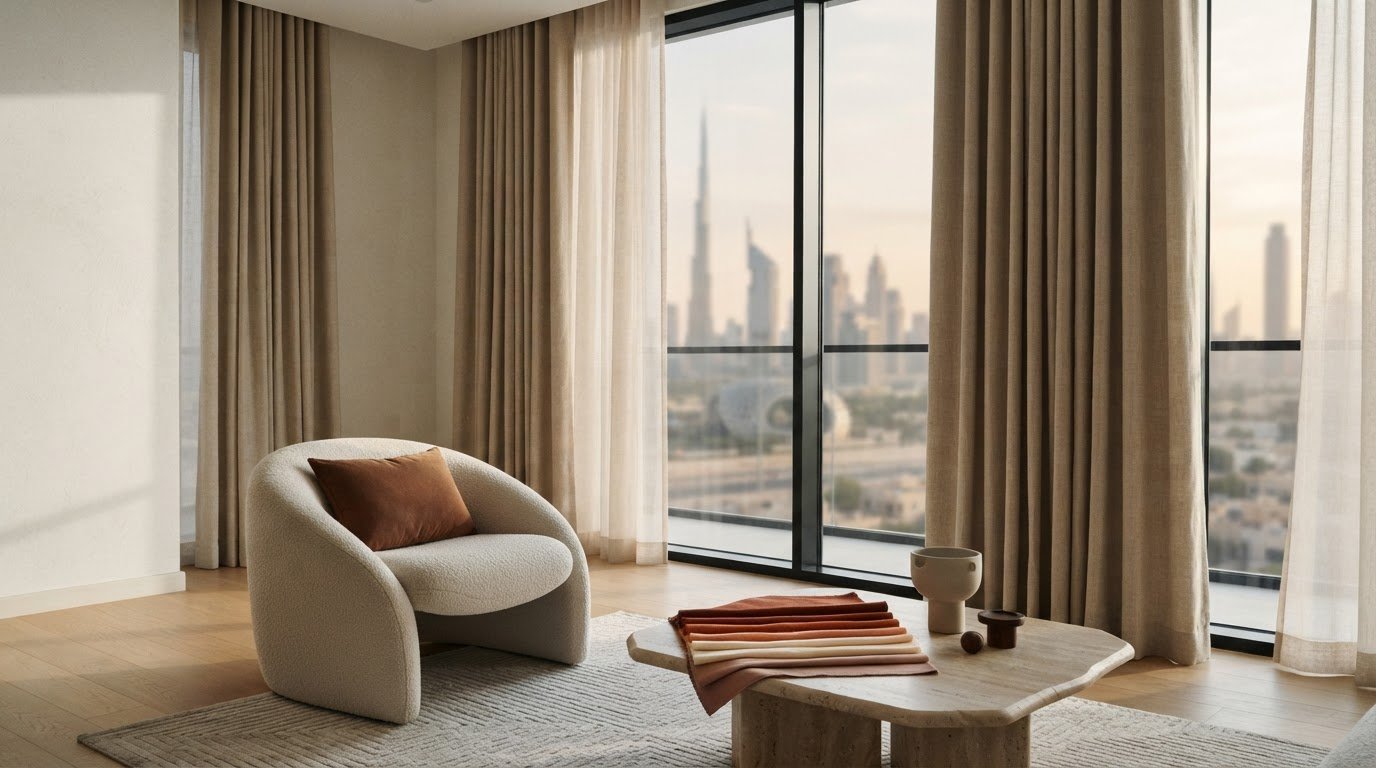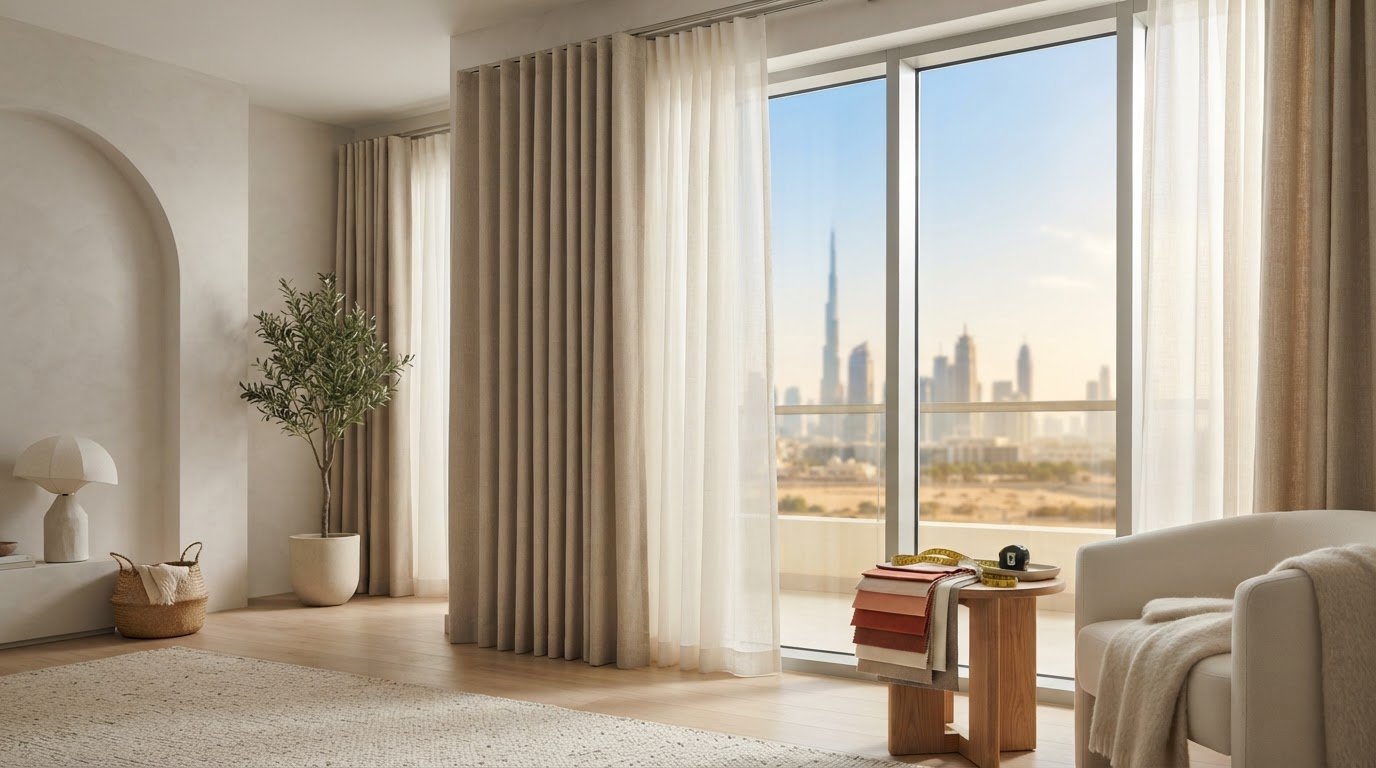

The most beautiful curtain in a showroom may be the wrong choice for your Dubai home. If you’re wondering how to choose curtains Dubai homes call for, start with the room’s sunlight, privacy needs, and everyday use, not a passing trend. Strong sun can make light control and fabric choice especially important, while a bedroom, living room, and home office each call for a different balance.
It’s understandable to feel unsure when comparing sheer, lined, and blackout options, or deciding whether a fabric suits a particular room. This practical guide will help you match style, fabric, light control, and fit to your home, so you can make a considered choice rather than rely on appearance alone. We’ll explore how room function and window conditions shape your options, what to prepare before speaking with a curtain specialist, and where custom Pleated American curtains or Roman blinds may fit into the decision. Fabrico brings approximately 35 years of experience in Dubai, offering a knowledgeable local perspective as you weigh the details.
Key Takeaways
- Start with each room’s purpose, window direction, daylight, and privacy needs before choosing a curtain style.
- Learn how to choose curtains Dubai homes need by comparing sheers, lined curtains, blackout options, and Roman blinds against your priorities.
- Assess fabric weight, opacity, texture, care requirements, and how colours appear in your room’s lighting before deciding.
- Prepare window measurements and note obstructions, then have dimensions professionally verified before fabrication.
- Ask a curtain specialist to confirm fabric availability, lining, care, and the agreed measurement, fabrication, and installation scope in writing.
How Dubai sunlight, room use, and privacy shape curtain choices
Identify what the room needs to do before choosing a curtain style. A bedroom may call for greater privacy and less incoming light, while a living room may benefit from daylight and a view during the day. A window exposed to strong direct sun may need a different level of coverage from one that receives softer or limited daylight. This room-first approach is central to how to choose curtains Dubai homes can use comfortably every day.
There isn’t one ideal light-control choice for every window. Consider the room’s purpose, the direction and timing of sunlight, how visible the window is from outside, and whether you want to keep a view. To understand the range of curtain styles and types, it helps to distinguish the style of a treatment from its practical effect: a fabric’s opacity and the way it’s fitted influence how much daylight and outside visibility it allows.
Set the light and privacy goals for each Dubai room
Decide whether the priority is privacy, filtered daylight, a darker room, or a balance. Sheer fabric softens incoming light while typically retaining some visibility through the window; a more opaque option limits light and views further. The result depends on the chosen fabric and how it covers the window, so confirm the details rather than relying on a style name alone.
Observe each window at different times of day before settling on an opacity. Note when direct light enters, whether neighbouring buildings or a street affect privacy, and when the room is most often used. For example, a bedroom used for daytime rest may need more light control than a living room where occupants prefer a bright atmosphere. A sun-exposed window may call for fuller coverage, while still allowing you to choose how much daylight to retain.
Consider sunlight, heat, and everyday comfort
Sun exposure is a practical part of choosing curtains in Dubai, but a curtain’s effect depends on more than its appearance. Fabric weight and opacity, any lining, the amount of window covered, and how closely the treatment fits all shape the experience. Don’t assume that a particular colour or fabric will deliver a specific temperature change; ask about the properties of the actual textile and lining being considered.
Make a simple room-by-room note before comparing options:
- Bedroom: Record when you need privacy or a darker environment.
- Living room: Decide how much daylight and view you want to preserve.
- Sun-exposed window: Note the hours of direct light and whether fuller coverage suits the room.
These observations give you a clearer brief for comparing curtain styles, including custom Pleated American curtains and Roman blinds, without assuming either is right for every window.
Compare curtain styles and fabrics for Dubai homes
Once you know a room’s light and privacy priorities, compare the options by what they do, how they look, and how they fit the window. Sheer, lined, and blackout describe different levels or constructions of coverage; Roman blinds are a distinct window treatment style. The exact result depends on the fabric and how it’s made, so confirm the material and care instructions for the specific option you’re considering.
Sheers: Offer filtered daylight and a light, airy appearance, but usually provide limited privacy after dark when interior lights are on. Consider them where maintaining daylight matters, with another layer if privacy needs change.
Lined curtains: Add a layer behind the face fabric, which can alter its drape and appearance and provide more coverage than an unlined sheer. The effect on light and privacy depends on the lining and face fabric; ask what the selected combination will allow.
Blackout options: Intended for stronger light blocking than sheers or standard lined curtains. They may suit a bedroom or another room where reducing incoming light is a priority, but confirm the fabric and coverage rather than assuming the label means the same result in every installation.
Roman blinds: Fabric blinds that fold into horizontal sections as they’re raised, creating a neater profile at the window than full-length curtains. They may suit a room where that tailored appearance works with the layout, though the fabric still determines the look and degree of light control. If you want a more streamlined alternative for modern interiors, you can also explore Roller Shades to see how different shade styles manage daytime sunlight and glare.
Choose coverage for the way you use the room
Sheers can soften daylight in a living space, while a lined or blackout option may better suit a bedroom where occupants want stronger light control. If needs shift through the day, consider layering a sheer with a more opaque curtain, provided the window and room layout can accommodate both. Don’t treat lined and blackout as interchangeable: ask specifically about the intended opacity, privacy, and care requirements.
Full-length curtains create a continuous fabric statement around a window; Roman blinds keep the treatment closer to the window opening. The right choice depends on the window’s proportions, nearby furniture, and the visual effect you prefer. Fabrico offers custom Pleated American curtains and Roman blinds, but suitability depends on your room and chosen materials. For more detail, see the American pleated curtains guide and the Roman blind fabric guide.
Fabric composition, weave, weight, and construction affect drape, appearance, and maintenance. Since current fabric and lining availability should be confirmed, ask to review suitable options and their care requirements before deciding. That comparison is a practical step in how to choose curtains Dubai homes need. You can also explore Fabrico’s curtain options as a starting point for discussing the room’s requirements.
Match curtain fabric, lining, and colour to the room
A fabric that looks appealing on a small sample can feel quite different once it covers a full window. Consider its weight, texture, opacity, and drape alongside the room’s use. A heavier fabric may create a fuller visual effect, while a lighter one may hang more softly. The weave and construction also influence how the material looks and how it should be cared for. These details matter as much as colour when deciding how to choose curtains Dubai rooms can accommodate well.
Assess fabric samples in the room where curtains will hang
If samples are available, compare them beside the flooring, wall colour, and nearby upholstery. View each in daylight and again under the room’s usual artificial lighting, since a shade can appear warmer, cooler, lighter, or deeper as the light changes. Check the texture closely and ask how the fabric hangs at full length or when gathered. Confirm opacity and care instructions too, especially if the curtains will be used in a frequently occupied room.
Light colours can help a window feel visually open, but may show marks more readily depending on the fabric and household use. Darker colours can create contrast or a more enveloping appearance, yet may look different under strong daylight than they do in a showroom. Neither is automatically the better choice. Judge the shade alongside your finishes and the amount of light the window receives.
Select lining, colour, and protection with care
Lining can change a curtain’s opacity, drape, and overall feel. Before selecting it, clarify whether your priority is greater privacy, reduced incoming light, or a particular finish. Ask how the lining pairs with the face fabric and how the combined textile should be cleaned. The final effect depends on the materials and their construction, so avoid assuming that one lining choice performs the same way with every fabric.
Also consider the window’s sun exposure and the household’s everyday needs. Ask whether the selected textile is suitable for that setting and what care its manufacturer recommends. Fabrico offers stain- and water-repellent fabric treatment, but suitability should be confirmed for the specific curtain fabric before proceeding. A treatment should not be assumed to make a textile stain-proof or easier to clean in every circumstance.
Before confirming your choice, make a short comparison of the fabric’s appearance, feel, opacity, care needs, and compatibility with any lining or treatment. Fabrico’s current fabric and colour selection should be verified directly, along with the suitability of any proposed treatment for the chosen material.
Use a practical checklist to choose curtains in Dubai
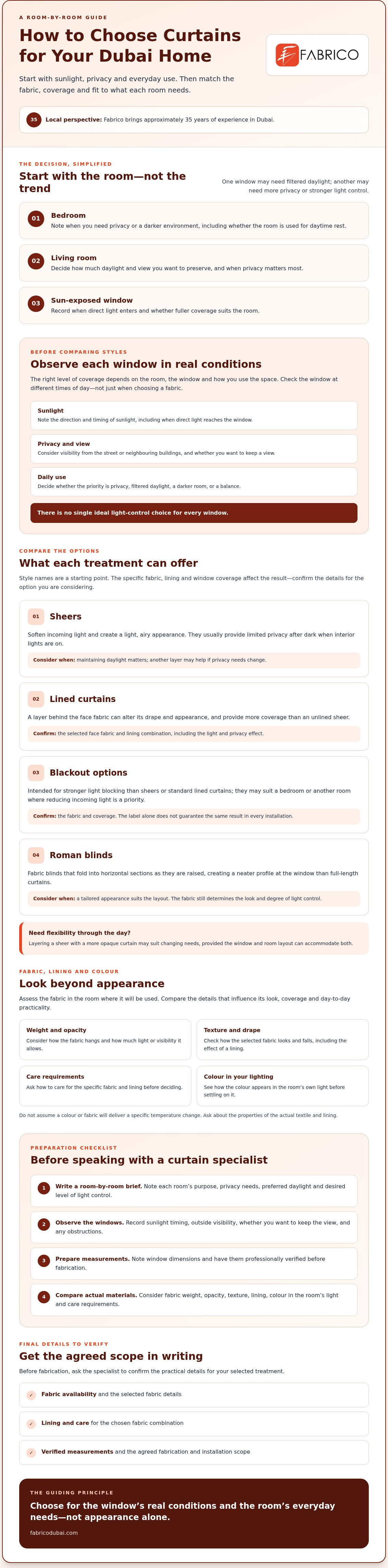
A short room-by-room brief makes it easier to compare options and explain what matters to you. Use this checklist to organise your priorities before speaking with a provider. Your notes are a starting point, not a substitute for accurate measurements: confirm who will verify dimensions and what the provider’s process includes before fabrication.
Prepare a room-by-room curtain brief
For each window, note its room, approximate width and height, sunlight exposure, and privacy needs. Add nearby furniture, flooring, wall colour, and upholstery, along with your preferred colour direction and cleaning preferences. Separate essentials, such as privacy or a particular level of light control, from optional preferences like a specific visual effect. This helps you compare choices against what each room actually needs.
- 1. Define the room’s priorities. Record whether you want privacy, filtered daylight, stronger light blocking, or a balance.
- 2. Note the window conditions. Write down approximate dimensions, when sunlight reaches the window, and any obstructions such as furniture, handles, or nearby fixtures.
- 3. Describe the desired coverage and fitting. Note whether you prefer full-length curtains or a treatment closer to the window, and record any track or fitting preferences to discuss.
- 4. List household and care needs. Consider who uses the room, how often the curtains may need cleaning, and whether the fabric’s care instructions suit your routine.
- 5. Compare samples in place. Review shortlisted fabrics beside the room’s finishes in daylight and under usual artificial lighting. Ask about opacity, lining, drape, and care.
- 6. Confirm details before proceeding. Request written confirmation of the selected materials, dimensions, included work, and agreed next steps.
Review samples, measurements, and service details
Approximate measurements help you prepare, but have the dimensions professionally verified before fabrication. Ask who is responsible for checking them, how obstructions will be considered, and whether the quotation includes measurement, fabrication, fitting, or installation. These arrangements and the scope of work can vary by provider, so don’t assume an item is included unless it’s confirmed.
Before making a decision, revisit your essential requirements and check that the proposed fabric, lining, coverage, and care expectations match your brief. Clarify any unresolved details in writing. This considered preparation makes how to choose curtains Dubai homeowners will be comfortable with a more straightforward process. Once your checklist is ready, discuss your curtain requirements with Fabrico and confirm the details relevant to your window and chosen materials.
Choose a Dubai curtain specialist for a confident final decision
A considered recommendation should connect your room’s requirements to specific materials and a clearly defined scope of work. As you decide how to choose curtains Dubai homes can use comfortably, look for precise answers about fabric suitability, light control, privacy, care, and the steps involved, rather than relying on broad claims about quality or performance.
Questions to ask before confirming a curtain order
Bring your room notes and ask the provider to explain how the proposed fabric and lining relate to your stated priorities. If you need a darker bedroom or more privacy at a street-facing window, confirm what the selected materials are intended to do and what they won’t address. Check current fabric and lining availability, care instructions, and whether any recommended treatment is compatible with the chosen textile.
- Measurements: Who verifies the final dimensions, and how will window features or obstructions be considered?
- Fabrication: What materials, lining, dimensions, and specifications will be used?
- Installation: What does the quoted scope include, and are fitting or installation arrangements separate?
- Care: What cleaning guidance applies to the selected fabric and any lining or treatment?
- Written terms: Can the provider confirm the agreed specifications, inclusions, and next steps in writing?
Clear documentation gives both parties a shared reference before work proceeds. Review it carefully and resolve any uncertainty about measurements, selected materials, or service terms rather than assuming a detail is included.
When to speak with Fabrico about custom curtains
Tailored advice can be useful for unusually shaped or sized windows, rooms with changing light and privacy needs, or several rooms that need a considered relationship in colour and fabric. Fabrico is a Dubai-based soft-furnishings specialist with approximately 35 years of experience in the local market. Its confirmed curtain offerings include custom Pleated American curtains and Roman blinds. These are options to discuss, not a universal fit for every window; suitability depends on your room, requirements, and the materials currently available.
Share your priorities and ask which options may be appropriate, then confirm fabric availability, measurement arrangements, fabrication details, and installation scope directly. For a calm next step, explore curtain and window-treatment options with Fabrico and discuss the requirements of your rooms.
Make a confident choice for every room
A thoughtful curtain choice starts with the room, not a trend. Match light control and privacy to how you use each space, then compare fabric, lining, colour, and care requirements in the room where the curtains will hang. Before confirming an order, have measurements and the agreed scope checked so the selected materials and next steps are clear.
That room-by-room approach is the practical foundation of how to choose curtains Dubai homeowners can feel confident about. Fabrico brings approximately 35 years of experience in the Dubai market, with custom Pleated American curtains and Roman blinds among its confirmed offerings. The right option depends on your windows, priorities, and the materials currently available.
Have your room notes ready and discuss your curtain requirements with Fabrico. With clear priorities and considered advice, you can choose a solution that feels right for your home and daily routine.
Frequently Asked Questions
Is blackout fabric always the best choice for a bedroom in Dubai?
Not necessarily. Blackout options may suit people who want stronger control over incoming light, but some bedrooms are more comfortable with softly filtered daylight or layered curtains. Consider the window’s orientation, privacy needs, sleep routine, and the look you prefer. Before deciding, review fabric and lining samples in the bedroom’s lighting, and ask the provider to explain the specific light-control characteristics of the selected materials.
Which curtains are best for a sunny window in Dubai?
There isn’t one best option for every sunny window. To decide how to choose curtains Dubai homes need for a particular exposure, consider how much daylight, privacy, and light reduction you want, then compare suitable fabric, lining, and coverage. Review samples in the room and ask about the textile’s care requirements and suitability for sun exposure. Don’t assume a colour or fabric alone guarantees heat or UV protection.
Should I choose curtains or Roman blinds for my Dubai home?
Choose according to the window, room layout, and appearance and function you prefer. Full-length curtains can create a flowing or layered look, while Roman blinds use fabric that folds as the blind is raised. Compare available space around the window, desired light control, and maintenance needs. Fabrico offers Pleated American curtains and Roman blinds; contact the company to confirm current fabric and customisation options before making a selection.
Are sheer curtains enough for privacy in Dubai?
Sheer curtains can soften daylight and provide some screening, but may not offer the privacy you want after dark when interior lights are on. Consider what can be seen through the window, including views from nearby buildings, and how the room is used at different times. If privacy requirements change during the day, compare layered options or pair sheers with a more opaque curtain, subject to suitable space and materials.
How do I choose curtain colours and fabrics for a Dubai room?
Start with the room’s existing finishes, sunlight, and practical requirements rather than choosing from a screen alone. Compare fabric samples beside the walls, flooring, and upholstery, and view them at different times of day. Check texture, opacity, drape, and cleaning instructions. Before confirming your choice, ask the supplier whether the specific fabric, any lining, and any proposed treatment suit the window’s exposure and your intended use.
Should curtains be measured before or after choosing the fabric?
First shortlist the style and fabric requirements, then confirm who will take and verify final measurements before fabrication. Curtain type, track placement, desired coverage, and fitting details can affect the dimensions needed. Approximate measurements are useful for starting a discussion, but shouldn’t be treated as production measurements. Ask your chosen provider to explain who verifies the final dimensions, how obstructions are considered, and what the measurement process includes.