
Will a cover that almost fits protect what’s underneath? In Dubai and across the UAE, outdoor furniture and equipment can be exposed to strong sun, heat, dust and occasional rain. Outdoor equipment covers UAE homeowners and businesses choose should suit the item’s shape, arrangement and location, not just its general category.
Ready-made dimensions can be difficult to match, especially for unusual shapes or equipment with attachments. Start with careful measurements and a clear description of how and where the cover will be used. A standard size may suit a straightforward setup; a tailored cover can be more practical when the dimensions or contours differ.
This guide explains what to measure, how to describe the intended use and what to consider when selecting protection for the UAE climate. It also covers when custom sizing makes sense. Fabrico makes bespoke outdoor protection covers for residential and commercial clients in the UAE, drawing on approximately 35 years of experience in Dubai.
Key Takeaways
- Outdoor equipment covers UAE: match the cover to the item’s shape, arrangement and exposure, not dimensions alone.
- Measure carefully and note attachments or grouped pieces so the brief reflects the actual setup.
- Use clear photographs and describe the location, including exposure to sun, dust, heat and occasional rain.
- A standard cover may suit a familiar, close-fitting configuration; unusual shapes or arrangements can benefit from bespoke sizing.
- Fabrico makes bespoke outdoor protection covers for residential and commercial clients, with approximately 35 years of experience in Dubai.
What Protection Do UAE Outdoor Equipment Covers Provide?
An outdoor cover sits over furniture or equipment when it is not in use. It can reduce direct exposure to outdoor conditions, but its effectiveness depends on its fit, construction and intended use. A tailored cover is planned around a particular item or arrangement. A loose, general-purpose cover may provide a temporary barrier, but gaps, excess fabric or shifting can leave parts exposed or make the cover awkward to use.
This matters in Dubai and across the UAE, where outdoor items may face intense sunlight, high temperatures, airborne dust and occasional rain. Dust can settle on cushions, furniture and equipment, while rain may leave items damp, especially where water collects. A cover can help limit direct exposure, but it is not a substitute for suitable care or a guarantee against every weather condition.
No single specification suits every outdoor setting. A compact piece of equipment has different requirements from a wide dining set or a row of seating. Choose material and construction based on the intended use; general information on types of tarpaulins and their materials can help explain how coverings vary. For a broader overview of cover choices, see the outdoor protection covers guide.
Which outdoor items can a protective cover be made for?
Chairs, tables and outdoor seating need different cover shapes from equipment such as a grill or storage unit. The item’s height, width, depth, contours and protruding parts all affect the brief. A cover planned for one chair, for example, needs to account for that chair’s outline and may not suit a different model.
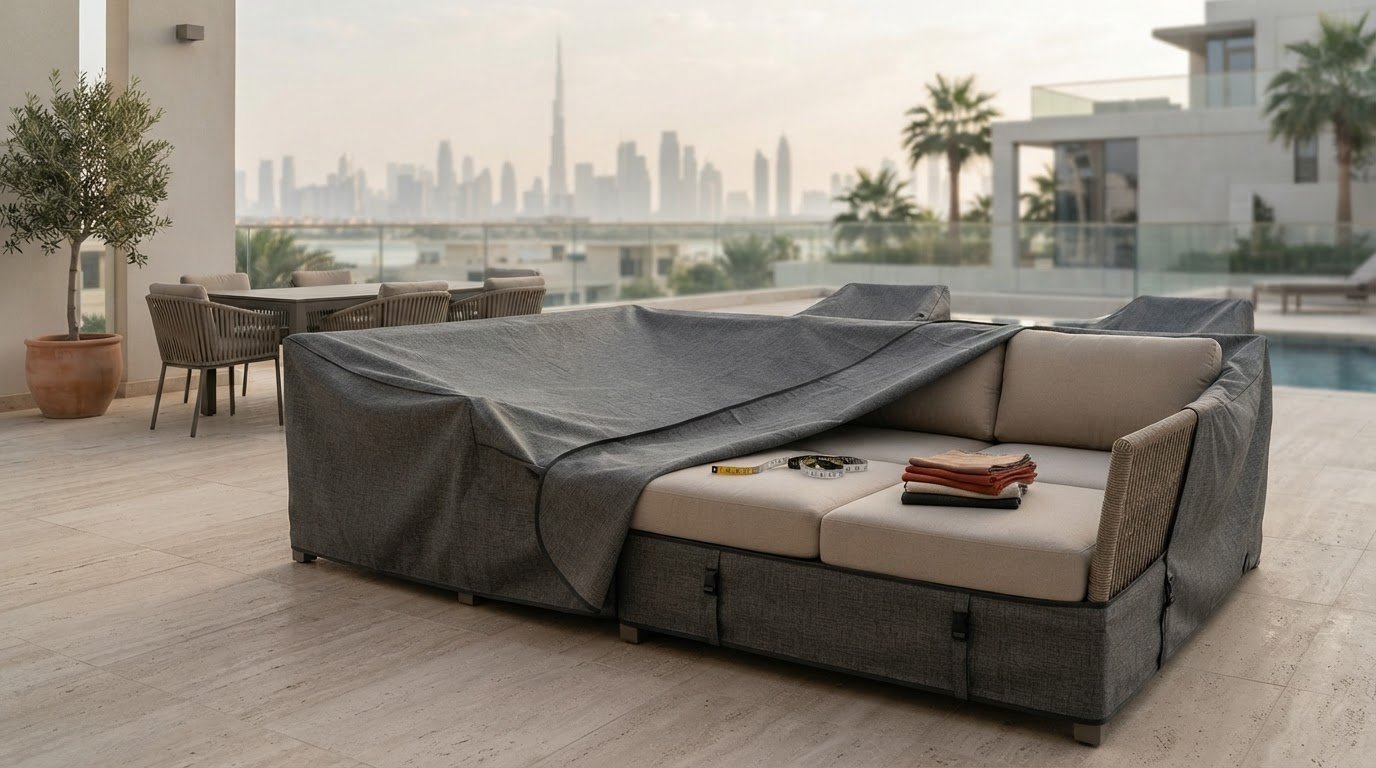
Arrangement matters as well. A cover for one item can follow its individual dimensions; a cover for grouped furniture needs to account for the full layout, including spaces and variations between pieces. Describe what will sit underneath and how it is positioned instead of relying on a broad label such as “patio set.”
What UAE outdoor exposure should buyers consider?
Consider where the item sits and what it encounters during normal use. An open terrace may receive direct sun and airborne dust, while a shaded area can still be exposed to heat, windblown dust or rain. A sheltered location may reduce direct exposure, but nearby walls or a roof can affect how the cover fits around the item.
In the UAE, choose a cover by matching its fit and construction to the item’s shape and the exposure at its location. Note whether you will use the cover regularly or mainly while storing the equipment, and include that purpose in the brief. These details help distinguish a practical cover for a protected balcony from one intended for a more exposed setting.
How cover fit and construction affect outdoor protection
Dimensions are the starting point, not the whole brief. Two items with similar overall measurements can have different outlines, while handles, legs, controls or fixed accessories may affect how a cover sits. For an unusual item or group of pieces, record the actual arrangement rather than relying on a broad product label. This gives a clearer basis for planning a cover around the setup.
Which measurements should you prepare?
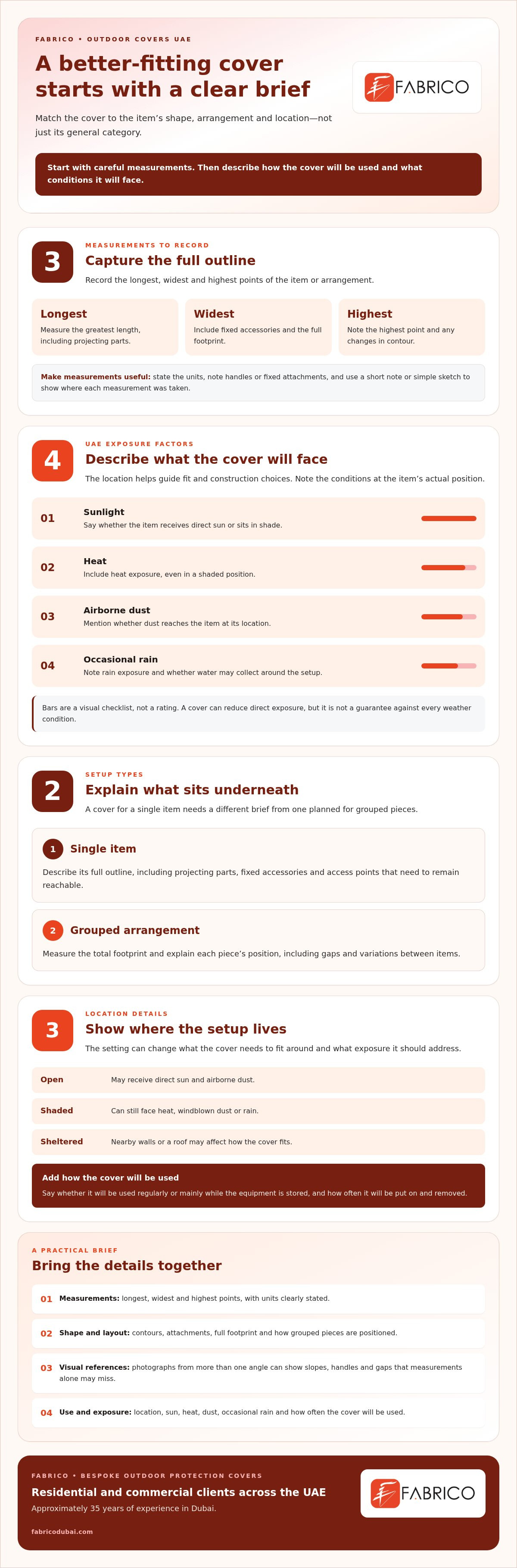
Record the longest, widest and highest points of the item or arrangement. Measure around projecting parts and fixed accessories that will remain in place under the cover. If several pieces will be covered together, note the full footprint and how they are positioned. Indicate whether the item sits against a wall or stands freely, since this affects which sides are accessible and how to describe its outline.
Use consistent units and state them clearly. A short written note or simple sketch can show where each measurement was taken, especially for irregular shapes. Photographs from more than one angle can reveal details that numbers alone may miss, such as a sloping back, extended handle or gap between grouped pieces.
How do fit and exposure relate to cover construction?
A cover should suit the item’s outline and intended use. If it is too loose, excess fabric may shift or catch; if it leaves gaps, parts of the item may remain exposed. These are practical fit considerations, not assurances about performance in every condition. Note openings, access points or parts that need to remain reachable, and describe how often the cover will be put on and removed.
Match cover construction to the item’s shape, how it will be used and the exposure at its location. Consider material and closure in relation to those needs. Don’t assume a feature or material suitable for one cover will suit another, or treat a general fabric characteristic as a confirmed specification for a particular cover. For related reading on fabric protection, see this water-repellent fabric treatment guide; it covers fabric treatment, not the specifications of outdoor covers.
A useful search phrase is “outdoor equipment covers UAE,” but a strong brief connects measurements with exposure. Describe whether the item is in an open, shaded or sheltered position and whether it is exposed to direct sun, dust, heat or occasional rain. This keeps material and construction decisions tied to real use rather than assumptions based on appearance.
- Single item: record its full outline, including fixed accessories and projecting parts.
- Grouped arrangement: measure the total footprint and explain the position of each piece.
- Location: note nearby walls or shelter and the exposure the cover is intended to address.
Fabrico makes bespoke outdoor protection covers for residential and commercial clients in the UAE. If your measurements describe a distinctive configuration, explore Fabrico’s tailored outdoor protection covers as an option planned around that setup.
Custom vs ready-made outdoor covers: which suits your UAE set-up?
The choice is not simply between a standard size and a bespoke one. It depends on how closely the cover’s dimensions and shape match the item, how many pieces it needs to cover and how it will be used. A straightforward item with familiar proportions may suit a standard cover if its stated measurements correspond to the item. Unusual outlines, fixed accessories or a specific group arrangement can make a tailored cover more practical.
There is no universal cover for every chair, table, machine or outdoor setup. Items with the same general label can still differ in dimensions and shape. A cover selected by category alone may not account for the item’s full outline or the arrangement of several pieces. When comparing outdoor equipment covers UAE buyers are considering, match the actual setup to the cover’s stated dimensions, not just its product name.
When can a ready-made cover be a practical choice?
A standard cover can suit a straightforward shape when its stated dimensions align with the item’s full measurements and intended configuration. Compare length, width and height, including fixed parts that affect the outline. A category listing can help identify the type of cover, but it does not establish an exact fit by itself. Check the dimensions and the arrangement the listed size is intended to cover.
This can work for a single, regularly shaped item without unusual projections or a complex layout. It is less reliable when the listing leaves important details unclear, such as whether measurements refer to the item itself or a larger arrangement. In that case, choosing by product category alone can lead to an awkward fit.
When does a custom outdoor cover make more sense?
A tailored approach is worth considering for irregular outlines, non-standard dimensions, fixed accessories or several pieces that need to be covered together. The brief can describe the item’s particular form, arrangement and intended use instead of adapting the item to a generic size. This is especially relevant when a standard dimension does not reflect the complete setup.
For example, a table and chairs arranged together have a different outline from a single chair, even if each piece is a familiar type. Equipment with an attached handle or control may also need its shape described rather than reduced to a generic label. Clear measurements and an explanation of the arrangement help define the requirements.
Fabrico makes bespoke outdoor protection covers for residential and commercial clients in the UAE. A tailored cover can be planned for an individual item or a distinctive arrangement, with the brief focused on its specific dimensions and use. Use this simple guide:
- Consider standard sizing when the item is straightforward and its full measurements align with the stated cover dimensions.
- Consider custom sizing when the outline, dimensions or group arrangement differs from a typical configuration.
How to prepare a clear brief for an outdoor equipment cover
A well-organised brief turns a specific outdoor setup into useful information for planning a cover. Include more than the item’s name: its dimensions, shape, arrangement and location can all affect what the cover needs to accommodate. This is especially useful for outdoor equipment covers UAE homes and businesses need for items with unusual outlines or fixed accessories.
Work through these steps and keep your notes together:
- Identify the item. Name the furniture or equipment and note how many pieces need covering. For a group, describe which pieces sit together and their usual positions.
- Record the dimensions. Measure the longest, widest and highest points of each item or the complete arrangement. Include handles, arms, controls and other fixed features that affect the outline. State the units and where you took each measurement.
- Describe the shape and placement. Note sloping, curved or irregular sections, and whether the item stands freely or sits against a wall. Explain which sides are accessible and whether any parts need to remain reachable.
- Explain the setting and intended use. Say whether the item is in an open, shaded or sheltered spot, and describe relevant exposure to sun, dust, heat or occasional rain. State what you want the cover to help protect against without assuming a specific material or technical feature.
What details belong in a cover brief?
Photographs make written notes easier to interpret. Take clear views from several angles, including the full arrangement and any detail that changes the outline. Pair the images with measurements and a short explanation of the setting. This gives a more complete picture than a close-up or a general description such as “outdoor seating.”
Keep the brief factual. Distinguish fixed features from parts that move or are removed before covering the item. If the arrangement changes, explain which configuration the cover is intended for. These details describe how the item is actually used without prescribing construction features that may not suit every project.
How can you check the fit after receiving a cover?
Compare the cover with the item and arrangement described in the brief. Check whether it sits over the intended outline, covers the required areas and can be put on and removed as expected. Look for exposed parts or excess fabric that interferes with access. These are fit observations, not a guarantee of performance in every weather condition.
Keep the original measurements, photographs and agreed requirements together for future reference. Follow the care guidance supplied for the particular cover rather than assuming all covers should be cleaned or stored the same way. A concise record also makes it easier to describe any changes to the item or arrangement.
For a cover shaped around a specific item or configuration, request a bespoke outdoor protection cover from Fabrico, which makes tailored covers for residential and commercial clients in the UAE.
Fabrico outdoor protection covers tailored for UAE homes and businesses
A cover planned around a specific item starts with understanding its form and use. Fabrico is a Dubai-based specialist with approximately 35 years of experience, making bespoke outdoor protection covers for residential and commercial clients in the UAE. The process starts with a brief that describes the actual item or arrangement, rather than relying on a general category name to represent its dimensions.
Outdoor equipment covers UAE customers need may be for individual furniture, equipment or grouped configurations. A home terrace in Dubai and a commercial outdoor area can differ in the items involved, their arrangement and their exposure. Sharing these details helps focus the project on its requirements instead of assuming one cover design or specification suits every setting.
A tailored cover for your specific outdoor arrangement
A bespoke cover can suit an item with an unusual outline, non-standard dimensions or fixed features that affect its shape. The same applies to several pieces intended to sit under one cover. A clear brief connects those details to the cover’s intended setting and use, keeping the discussion focused on the specific configuration rather than a generic size.
Useful details include the item type, measurements, photographs and whether the cover is for one piece or a group. Describe the location as well, including whether it is open, shaded or sheltered. This context distinguishes a cover for an exposed outdoor area from one for a more protected position, while leaving material and construction choices to the requirements of the project.
Discuss your outdoor cover requirements with Fabrico
Whether you’re planning protection for a residential outdoor space or a commercial setup, bring together the details that best describe the project. A concise brief gives the conversation a clear starting point. Include:
- Item and arrangement: identify what needs covering and how many pieces are involved.
- Dimensions and form: record the overall measurements and note features that change the outline.
- Setting and use: describe the location, exposure and what you want the cover to help protect against.
Fabrico’s Dubai base and long experience in the local market provide a knowledgeable foundation for discussing a tailored outdoor protection cover. The brief does not need to prescribe a technical specification; accurate details about the item and its use are a helpful place to begin. For a made-to-measure approach suited to your configuration, Explore Fabrico’s outdoor protection covers.
Plan Your Next Step Towards a Better-Fitting Cover
Start by deciding which item or outdoor arrangement needs a cover. Consider how it is used, where it sits and whether the setup is likely to change. This helps you focus on a cover that suits the space in practice, rather than choosing by appearance alone. For outdoor equipment covers UAE conditions demand, a considered brief is a useful starting point for a tailored conversation.
If you’re preparing a project, gather details that show the item as it is used today. Clear information can turn a general requirement into a focused discussion about a made-to-measure option. Fabrico makes bespoke outdoor protection covers for residential and commercial clients in the UAE.
Ready to discuss a cover for your setup? Explore Fabrico’s bespoke outdoor protection covers.
Frequently Asked Questions
How much do custom outdoor equipment covers cost in the UAE?
The cost depends on the item’s dimensions, shape, configuration and requirements. A cover for one compact item differs from one designed for a large or grouped arrangement. Include measurements, photographs and a description of where the item sits outdoors in your brief. This keeps the proposed solution relevant to your setup rather than comparing a bespoke cover with an unrelated standard product.
Are outdoor furniture covers waterproof or water-resistant?
Waterproof and water-resistant describe different levels of protection, so don’t treat the terms as interchangeable without product-specific information. Protection depends on a cover’s materials and construction. Consider whether the item is in an open area exposed to rain or under shelter, and use that context when assessing its needs. Follow the care guidance for the particular cover, since outdoor covers do not all offer the same protection.
Can an outdoor cover protect furniture from UAE dust and sun?
A suitable cover can help shield an item from dust and direct sunlight, but the result depends on its fit, construction and intended use. Seating on an open terrace in Dubai, for example, may experience different exposure from furniture beneath a roof or in a shaded corner. Describe the actual setting when selecting protection. Outdoor equipment covers UAE buyers consider should not be treated as a guarantee against every weather or environmental condition.
How do I measure outdoor furniture for a cover?
Measure the furniture in the position it will occupy when covered, including parts that extend beyond its main frame. For a set, decide whether you need one cover over the group or separate covers for individual pieces, then record the dimensions for that choice. Photographs from the front, side and above can clarify proportions. Note the units and label each measurement so it is easy to interpret later.
Can one outdoor cover fit different furniture pieces?
One cover may suit different pieces only if their combined shape and dimensions match its intended fit. A table and chairs pushed together create a different outline from the same pieces spaced apart, while arms or projecting frames can change the overall shape. Measure the arrangement you plan to cover, not a possible alternative. If the layout changes often, separate covers may be more practical.
How can I reduce moisture building up under an outdoor cover?
Moisture management depends on the weather, the condition of the item and the cover’s fit. Make sure furniture is dry before covering it, and follow the care instructions for both the item and its cover. Where practical, inspect the covered furniture periodically, particularly after humid or wet weather. Avoid assuming every cover prevents condensation; if you notice persistent dampness, review how the item is stored and the guidance for its specific cover.
Should outdoor covers be removed during strong winds or severe weather?
Whether a cover should stay in place depends on its fit, construction and conditions at your property. A loose cover may behave differently from one suited to the item’s shape, but no general rule guarantees that every cover is suitable in severe weather. Follow product-specific instructions and use sound judgement as conditions change. If the cover shifts, check that it is being used as intended and take care when handling it in windy conditions.
How often should I clean an outdoor equipment cover?
Cleaning frequency depends on local dust, exposure and the cover’s material and care instructions. Inspect it periodically, especially after dusty or wet weather, and remove loose dirt using the method recommended for that cover. Avoid harsh cleaners or methods unless its guidance allows them. During inspection, look for visible wear or changes in fit, and follow the care instructions before storing the cover for an extended period.